

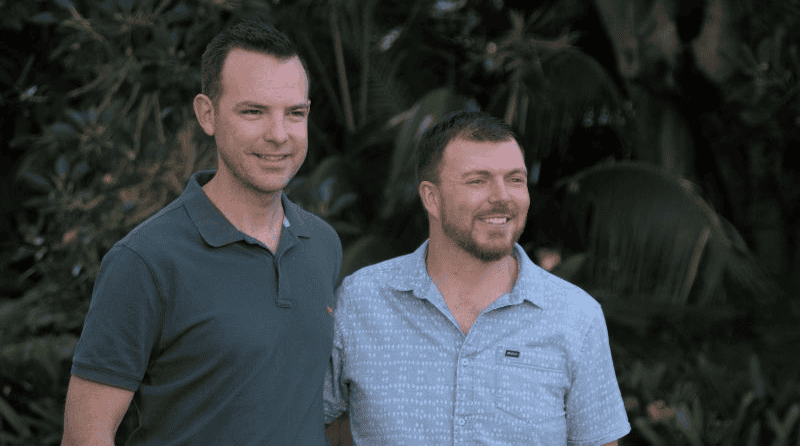
Trent and Brad Dunn have dreamed of starting a family for years, but they have also had to fight for the right to create their family through surrogacy. Now, the Esperance couple have become the first same-sex couple to be approved for a surrogacy agreement in Western Australia.
Brad and Trent have now been given the green light from the Reproductive Technology Council of Western Australia to proceed with plans to become parents via surrogacy. It comes a year ahead of when Western Australia’s new surrogacy laws are expected to take effect and follows a long and difficult legal battle by the couple, who challenged WA’s surrogacy laws in the Court of Appeal of the Supreme Court of Western Australia.

The Surrogacy Act 2008 (WA) currently requires that couples accessing surrogacy be heterosexual. The expectation was that same-sex couples wanting to become fathers through surrogacy would have to wait for the legislation to be amended or repealed, or pursue arrangements overseas in jurisdictions with fewer protections and less regulation than exists in Australia.
On Friday, it was revealed that earlier this year the Court found, by a 2-1 majority, that the state law preventing same-sex couples from accessing surrogacy in this way could not stand because it required the Family Court to discriminate against them in a manner that breached federal anti-discrimination law.
That cleared the way for the Reproductive Technology Council to approve Brad and Trent’s arrangement and move ahead without needing to wait for the new legislation to be implemented. While the new legislation passed Parliament in late 2025, it’s not expected to come into effect until mid-2027, giving public servants time to rewrite guidelines and associated regulations.
For Brad and Trent, together with their donor and their surrogate and her wife, that means the pathway towards parenthood continues, with treatment beginning this week.
“We know plenty of challenges still lie ahead of us, but we are overjoyed to now be focused on the wonderful opportunity of parenthood,” Brad said.
“When we started this legal battle many years ago, there was no guarantee if or when new laws would make it possible for us to become parents with the help of our surrogacy partners here in WA.
“It has been a very difficult and stressful battle, and we thank our friends and families who have supported us along the way.
“We also thank the medical and legal professionals. Without the generosity of the barristers in particular, we may not have been able to afford to bring the case at all.
“We specifically want to thank Rachel Oakeley, who drafted the arrangement and made the original application to the Reproductive Technology Council, and who then acted pro bono in the appeal, led by senior counsel Eric Heenan SC and joined by junior counsel Liam Nicholls, both of whom also acted pro bono.
“We also thank Matthew Glatzel of Bannerman Solicitors, who managed the Supreme Court application process, and Jen Chambers of Concept (now IVF Australia), who coordinated our surrogacy arrangement.”
The couple also shared advice for other same-sex couples considering surrogacy, stressing the importance of strong relationships and support networks.
“I would say the relationship is critical,” Brad said. “That’s the constant point. It’s the place you can return to, where you can ground yourself and anchor in those relationships.”
Brad outlined that not only is his relationship with Trent strong, but their relationships with their broader family, egg donor and surrogate are also strong and ongoing.
“Find a good community, surround yourself with supportive people, and keep pushing forward,” Trent said. “We’re hopeful this opens the door for other people in the same situation to access surrogacy, and that many other families will be able to follow in our footsteps.”
While Brad and Trent are celebrating this milestone publicly, they have deliberately chosen not to identify their donor, surrogate or her wife out of respect for their privacy.
Donating gametes and carrying a child for another family are profound acts of generosity. Brad and Trent expressed heartfelt thanks to their donor and surrogate family for helping make their dream of parenthood possible.
As a way of paying it forward, the couple are also sharing a template document with the LGBTQIA+ community, based on their surrogacy arrangement and stripped of identifying details. They hope it may assist other intended parents seeking to establish similar arrangements before the new legislation comes into effect.
Applicants will still require legal advice tailored to their circumstances. However, the template may reduce some initial legal drafting work and help lower legal costs.
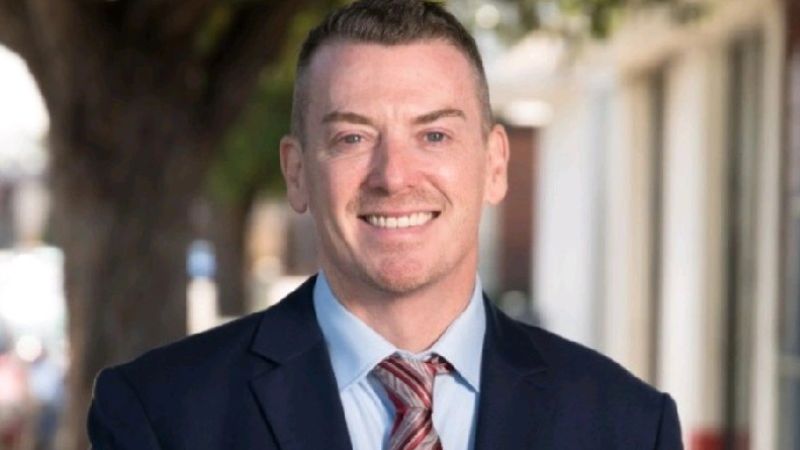
Paul Hadfield-Jia, Board Director and Secretary of Rainbow Families Australia, described the approval as a phenomenal result.
“Brad and Trent have simply wanted to start a family. Their courage and determination have now made that possible, while also opening a pathway for other same-sex couples who are ready to begin their own surrogacy journeys,” Hadfield-Jia said.
“By sharing the template developed with Rachel and their legal team, they may help other intended parents navigate what can be a complex and costly legal process.
“The impact of this case reaches beyond Western Australia. It sends a powerful message that discriminatory state laws and processes can be successfully challenged when they conflict with Commonwealth protections.”
Western Australia’s new legislation will eventually remove barriers to surrogacy and fertility treatment for same-sex couples.
However, with those reforms not expected to commence until mid-2027, Brad and Trent’s successful challenge has created an immediate pathway under the existing law.