


La Bola Negra | Dir: Javier Calvo and Javier Ambrossi | ★★★★½
La Bola Negra, which translates as ‘the black ball’, tells the stories of three interconnected Spanish men in three different times. They share the trauma, direct or inherited, that has resulted from society and history punishing homosexual men.

In Granada in 1932, amid tensions that preceded the Spanish Civil War, twenty year-old Carlos (Milo Quifes) finds out that his family’s wealth cannot protect him from the rumours that he is homosexual. He is denied membership to an elite gentleman’s club after the black balls outnumber white in the vote by the city’s prominent men.
Carlos’s father wants him to deny his sexuality in order to gain the membership which would reflect his social standing. As an aside, the film shows that the women in his family are confined to the domestic sphere, and have no social standing.
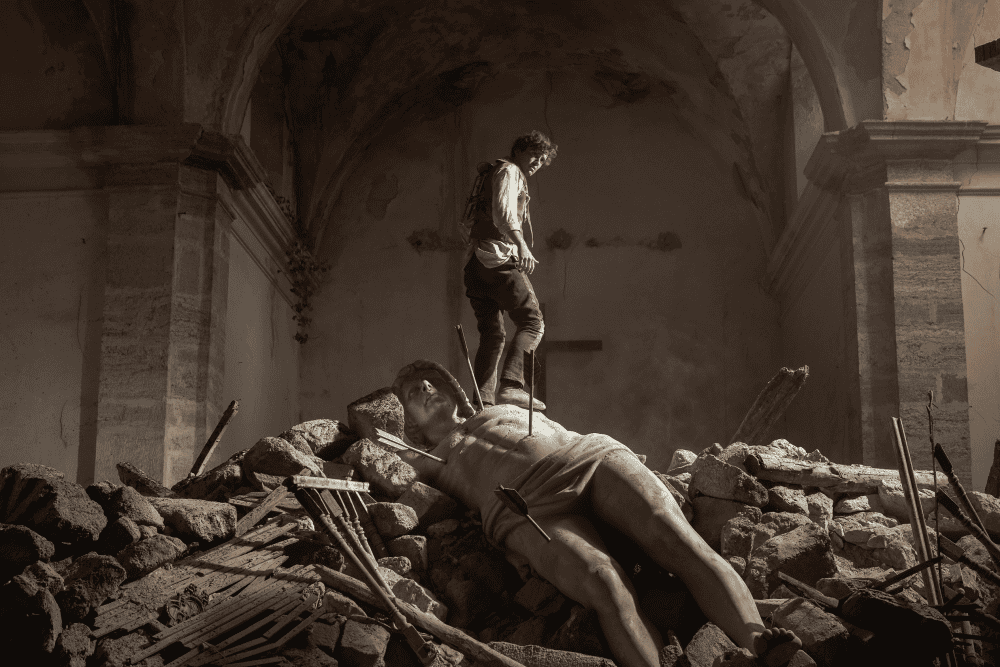
In 1939, Sebastián (Álvaro Lafuente Calvo) finds himself in the middle of the Spanish Civil War, after being press-ganged into the Pro-Franco Nationalist Army. Amid the chaos of battle, Sebastián scrambles over the rubble of the wrecked statue of Saint Sebastian who is widely regarded as the patron saint of homosexuality.
As a guard to captured Republican prisoner Rafael (Miguel Bernardeau), Sebastián falls in love with the impossibly handsome soldier, who has been wounded by bullets rather than arrows. This is the emotional anchor to this intense drama about the doomed impossibility of ‘forbidden love’.
In 2017, failed playwright Alberto (Carlos González) is doing research into queer identities and themes in popular music of the 1920s. He is not disadvantaged by judgments of his sexuality but he still lives under a cloud, and his mother Teresa (Lola Dueñas) is carrying a burden that has defined her life.
When Alberto inherits something from the grandfather he never knew, the pieces of the shattered puzzle begin to fit together. Although their circumstances differ, all three men have been hampered in finding their true expressions by having to keep part of their identities secret.
This grand 146 minute drama was inspired by the unfinished work of Spanish poet and playwright Federico García Lorca. According to the film’s directors, Lorca was killed in 1936 before he could finish his play about a young man excluded from a social club because he was gay.
Javier Calvo described the significance of the black ball in the title as a rejection that was passed down through generations, “associated with silence, pain and shame, as well as desire, love and joy.”
Enhanced by great performances, including cameo appearances from Penélope Cruz and Glenn Close, the emotionally powerful La Bola Negra received the longest standing ovation in the 2026 Cannes Film Festival.
La Bola Negra is screening at UWA’s Somerville from Monday 30 November at 8pm.
Lezly Herbert