


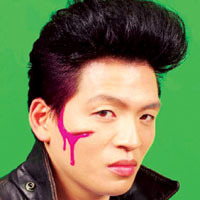
Australian writing has a new literary rock-star-come-superhero and his name is Tom Cho, author of the lysergic collection of short fiction Look Who’s Morphing. For Cho, transformation is a part of everyday life. With the release of his book he has transformed from a renowned zine maker into an author, one who used to work as a business analyst before an arts grant meant he could transform into a full-time artist. He even used to be recognised as a different gender. It’s this sense of transformation – or morphing – which runs through Cho’s collection of short stories.

Wait… ‘runs’ is to soft a word. Cho’s stories literally seethe and heave with a lysergic quality, yet do so in the most sublime and innocuous manner. These are stories which are confrontational without being leery. Here, Cho transforms into a 50 foot cock rocker, dons Suzi Quatro suits and shape shifts in all manner of ways. His is an imagination unafraid to play, one which spills out and creates writing that openly flirts with – if not actively beds – absurdity.
‘The absurdity of the stories was always a strong facet of the collection,’ Cho explained of his psychedelic fiction. ‘This is probably due to both my own playfulness and the collection’s focus on the broader theme of identity. Ideas of identity can be underpinned by many assumptions. Some of these assumptions are, frankly, ridiculous.
‘For example, I have personally been subjected to many assumptions based upon my ethnic background. As a child, some of the assumptions that were directed at me by other children were and are still laughable (e.g. the idea that I should naturally be good at karate). Yet, as an adult, some of the assumptions that are directed at me by other adults are equally if not more laughable (e.g. the idea that I should confine myself to writing about my ethnicity).
‘These assumptions are so absurd that, in writing a collection of fictions that explores identity as a theme, it was a very natural impulse for me to inflate this absurdity. As a result, much of the power of the book comes from how it skews established beliefs, how it reverses or challenges expectations. The characters in the book don’t behave as expected and the writing itself doesn’t behave as expected.’
It’s the unexpectedness, this combination of fantasy and logic in Cho’s writing that made his publisher – Ivor Indyk from Giaromondo Publishing – sit up and pay attention. ‘His transformations are sudden, surreal, fantastic,’ Indyk explained further. ‘But once they have happened, Tom sets about exploring their implication with all the rigour of a logician. He reminds me of Jonathan Swift in this respect, for his analogies could be really strange too and treated by him with the greatest seriousness.’
For Cho there is also an incredibly performative aspect to his work. To see him read is to see Cho come alive, the nuance of his work and its intrinsic humour bristling to the fore as he dips and weaves into one character after another. ‘Many pieces from the collection have been performed at various spoken word gigs over the years (especially to queer audiences) and so were also developed with a live audience in mind,’ Cho explained.
‘The piece that was most explicitly written with performance in mind is “AIYO!!! An evil group of ninjas is entering and destroying a call centre!!!â€. It’s in colloquial Malaysian English (‘Manglish’), which itself is an oral variety of language anyway. So, consider lines like “Aiyo! What about her legs-lah?! She got no legs! During the explosion her legs got blown off far, far away! Aiya! She needs legs-lah!!!†Despite the fun of having excessive exclamation marks on the page, these lines best come to life on the stage.’
What adds to the power of this book is the front cover. On it is Cho himself, big Fonz quiff, big black leather jacket, big sideburns… and a big gash gushing a big blob of hot pink goo. Not blood, goo. Cho appearing on his own front cover is a move which reflects the autobiographical nature of the book
‘I became interested in playing with the idea that I was ‘making the book all about me’. In fact, putting myself on the cover of the book was a way of extending this sense that I was making the book all about me. I also found it an interesting thing to do because an author generally doesn’t appear on the front cover of their book unless they’re famous.’
Look Who’s Morphing is available now. Be sure to read our review of this book online in our Blog section.
***