

Gilbert Baker, the designer who created the Pride flag, died on this day in 2017.
The rainbow flag that is a symbol for LGBTI+ communities was created by Baker for San Francisco’s Freedom Day celebrations in 1976. Originally the flag had eight colours, but since 1979 it has usually had six.

The colours were chosen to symbolise life (red), healing (orange), sunlight (yellow), nature (green), harmony (blue), and spirit (purple/violet). The removed colours stood for sexuality (pink) and art/magic (turquoise).
Baker created the flag after being challenged by gay rights activist Harvey Milk to design a symbol for the gay and lesbian community.
After Milk’s assassination in 1978, demand for the flag increased dramatically and it began to be commercially produced. Due to a shortage of pink fabric, the pink stripe was dropped; later, the turquoise stripe was removed so the flag would appear even when hung vertically.
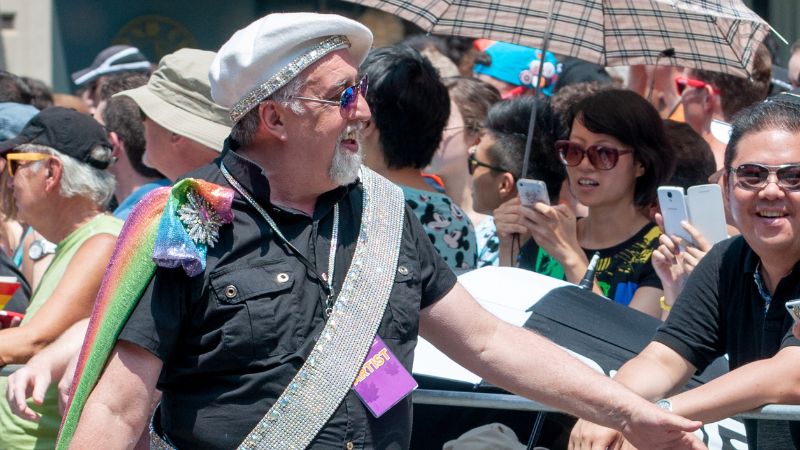
Baker said he wanted to convey the idea of diversity and inclusion, using “something from nature to represent that our sexuality is a human right”.
Born in Kansas, Baker came to San Francisco in 1970, where he served as a medic in the US Army. After he was discharged, he became involved in political activism and worked as a professional flag designer.
In 1994 he moved to New York City, where he lived for the rest of his life. For the 25th anniversary of the Stonewall Riots, he created what was then the world’s largest flag for the celebrations.
At the time of his passing, screenwriter Dustin Lance Black — who wrote the Oscar‑winning film Milk and the mini‑series When We Rise — paid tribute to Baker.
“Rainbows weep. Our world is far less colourful without you, my love. Gilbert Baker gave us the rainbow flag to unite us. Unite again,” Black posted on Twitter.
Veteran activist Cleve Jones also marked Baker’s passing, noting their long friendship.
“My dearest friend in the world is gone. Gilbert Baker gave the world the Rainbow Flag; he gave me forty years of love and friendship,” Jones wrote.
Since Baker’s passing, newer versions of the flag have emerged that incorporate the flags of transgender people, the intersex community, and the Black Lives Matter movement.
Singer Tracy Chapman was born on this day in 1964
Tracy Chapman burst onto the music scene in 1988 with her self‑titled debut album.
Her song Fast Car received unexpected additional exposure when she stepped in at the last minute to perform at a 70th birthday tribute concert for Nelson Mandela held in London. At the time Mandela was still a political prisoner in South Africa.
The song and album quickly raced up the charts, with additional hits Talkin’ ’bout a Revolution and Baby Can I Hold You following.
So far, Chapman has released eight albums blending folk and blues influences. Her most recent record was 2008’s Our Bright Future. While she appears to have stepped away from recording and performing live, a new generation of artists has shown appreciation for her songwriting.
There have been dance and country covers of Fast Car. American singer Luke Combs scored a number‑one hit with his take on the track. Chapman surprised audiences at the 2024 Grammy Awards when she took to the stage to perform alongside Combs.
Talkin’ ’bout a Revolution has been covered by Living Colour, Reel Big Fish, Chaka Demus & Pliers, and many others, but rapper Nicki Minaj ran into legal trouble when she sampled the song without Chapman’s permission.
Chapman has never spoken publicly about her private life, but she was in a relationship with The Color Purple