


On this day in 1989, artist Keith Haring publicly revealed that he was living with HIV. The announcement came at a time when few effective treatments were available and many people diagnosed with the virus faced a significantly reduced life expectancy.
Haring arrived in New York in the late 1970s, where he studied at the School of Visual Arts during the day and worked as a busboy at the nightclub Danceteria in the evenings.

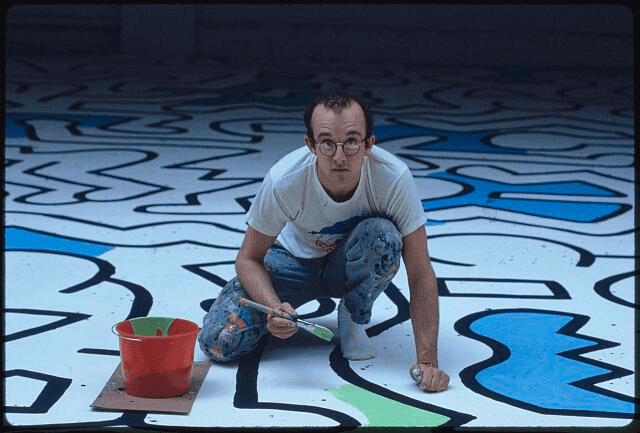
He first attracted attention through chalk drawings created on unused advertising panels in New York’s subway stations. Soon, his work moved from the streets into galleries, with his distinctive line-drawing style becoming known for its bold symbols, social commentary and accessibility.
As his reputation grew, Haring travelled the world undertaking major commissions. He visited Australia in 1984, painting murals in Melbourne and Sydney and creating a work for the National Gallery of Australia.
Haring also produced politically charged works, including his Silence = Death series, which highlighted what many activists viewed as the US government’s inadequate response to the AIDS crisis.
As an emerging artist in New York, Haring formed friendships with Jean-Michel Basquiat, Madonna, Futura 2000 and Kenny Scharf. He later collaborated with, or was associated with, artists and performers including Andy Warhol, Grace Jones and Yoko Ono. He was diagnosed with HIV in 1988.
Haring died on 16 February 1990 at the age of 31. He is commemorated on a panel of the AIDS Memorial Quilt. Madonna later donated the proceeds from the first New York performance of her Blonde Ambition tour to HIV-related charities in his honour. He is also name-checked in her recent hit Danceteria.
In 2019, Haring was among the first 50 Americans recognised on the National LGBTQ Wall of Honor at the Stonewall National Monument.
Today, his work is everywhere. His imagery appears on products ranging from caps and watches to backpacks and coffee cups. It is imitated on posters, celebrated in galleries and remains instantly recognisable more than three decades after his death.