

On 22 October 1989, more than 300 people gathered on the steps of Parliament House in West Perth to protest laws discriminating against gay men.
It was an important moment in Western Australia’s campaign for homosexual law reform and part of a much larger day of protest taking place across Australia and internationally.

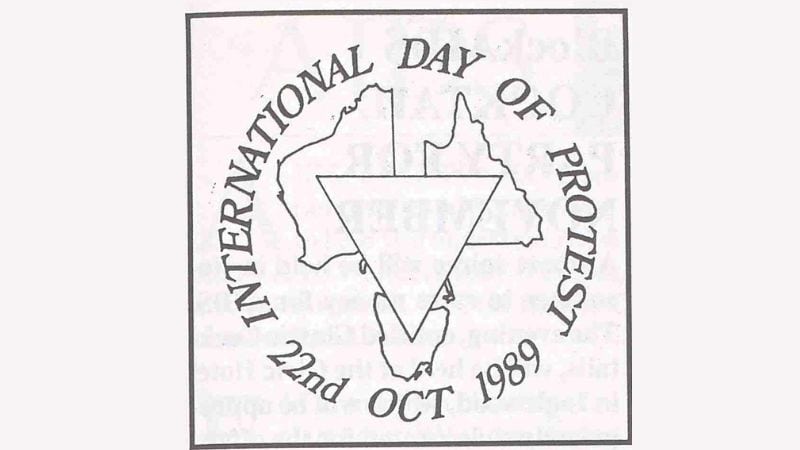
An International Day of Protest
The International Day of Protest grew from cooperation between gay law reform activists in Western Australia, Tasmania and Queensland, the three Australian states that still retained laws against consensual sex between adult men.
The date, 22 October, was chosen to coincide with the first anniversary of the Salamanca Place arrests in Hobart, where gay and lesbian rights activists had been arrested during a campaign over the right to operate a law reform information stall.
By September 1989, support had spread beyond Australia. Lesbian and gay organisations overseas were planning solidarity actions, while protests and supporting activities were being organised across Australia. Contemporary reporting presented the day not only as a campaign against discriminatory laws, but also as an opportunity to strengthen connections between gay and lesbian activists nationwide.
A “Show of Strength” in Perth
In Western Australia, the Gay Law Reform Group of WA (GLRG) had formed earlier in 1989 and was campaigning for reform through parliamentary lobbying, public education, media engagement and community mobilisation.
Six days before 22 October 1989, the GLRG announced that Perth would hold a “Show of Strength” rally at Parliament House.
The organisers were deliberate about its character. Rather than what they described as “loud and angry demonstrations/marches”, they called for a “peaceful and dignified demonstration” in support of law reform.
At 10 am on Sunday morning, more than 300 people answered that call.
Neil Roberts, a member of the GLRG committee and Chairperson of the WA AIDS Council, addressed the crowd, followed by long-time law reform campaigner Tony Whelan.
A pink-triangle wreath was placed on the steps of Parliament House by Margaret Pugh and Gavin McGuren. The crowd sang I Am What I Am before releasing 200 pink and mauve balloons.
The protest attracted extensive television, radio and newspaper coverage. Westside Observer subsequently reported that Perth recorded the largest turnout of the Australian protests.
The Risks of Being Visible
For those who participated, public visibility could carry real consequences.
The following month, Westside Observer reported the account of an unidentified Perth gay man who alleged that he lost his job after his employer saw him on television at the Parliament House rally. According to the report, he believed that his sexuality and attendance at the protest contributed to his dismissal.
At the time, Western Australia’s equal opportunity legislation did not protect people from discrimination on the grounds of sexual orientation.
His story provides a powerful reminder that publicly standing on the steps of Parliament House in 1989 and being identified as gay was not necessarily without personal risk.
Part of a Much Longer History
The 22 October event is sometimes retrospectively associated with the beginnings of Perth’s Pride movement. Contemporary reporting and organisational records, however, describe it as a rally, protest, meeting or demonstration. The GLRG itself later referred to it as “our first ever rally”, referring to the newly established organisation.
Importantly, it was not Perth’s first gay rights protest or march.
Organised homosexual and gay and lesbian activism in Western Australia had a much longer history. Groups including CAMP WA and Perth Gay Liberation had been organising, campaigning and protesting during the 1970s.
Public activism continued into the 1980s. On 22 March 1980, for example, a gay rights march took place through central Perth as part of a National Summer Action. Other organisations, activists and campaigns continued to pursue law reform, visibility and gay and lesbian rights throughout the decade, including the campaign that brought more than 300 people to Parliament House in October 1989.
A new chapter began in 1990, when organisations and community members came together to establish the Pride Collective and organise Perth’s first Pride Month. A Pride March was held in October as part of that month.
This marked the beginning of the particular organised Pride tradition from which Lesbian and Gay Pride WA, and today’s Pride WA, would develop, rather than the beginning of public gay and lesbian activism in Western Australia.
Decriminalisation – But Not Equality
The 1989 law reform campaign achieved an important change later that year.
The Law Reform (Decriminalization of Sodomy) Act 1989 received Royal Assent on 19 December 1989 and came into operation on 23 March 1990, decriminalising consensual sexual activity between adult men in private.
However, decriminalisation did not bring equality. An unequal age of consent and other discriminatory provisions remained, while gay men and lesbians still lacked protection from discrimination on the grounds of sexual orientation.
The struggle for equality therefore continued.
On 24 April 1990, the Gay Law Reform Group became the Coalition for Gay and Lesbian Equality, broadening its focus to anti-discrimination, equal opportunity and further law reform.
Thirty-seven years later, 22 October 1989 remains an important moment in Western Australia’s gay and lesbian history, and in the broader history of the communities now represented by terms such as LGBTQIA+SB, when more than 300 people stood together at Parliament House, made themselves visible and publicly demanded change.
Note on Terminology
This article uses terms such as gay, lesbian, homosexual and gay and lesbian where they reflect the language used by activists, organisations, legislation and contemporary sources in 1989.
Today, Western Australia’s diverse communities are more commonly described using broader acronyms such as LGBTQIA+SB, encompassing lesbian, gay, bisexual, trans, queer, intersex, asexual and other sexuality and gender-diverse identities, with SB (Sistergirl and Brotherboy) recognising culturally specific identities used by some Aboriginal and Torres Strait Islander people.
The broader contemporary acronym should not be taken to mean that every identity it encompasses was represented at, or described the participants in, the 1989 rally.
Guy Gomeze (he/they) is a social historian, researcher, curator, writer, artist and photographer whose work focuses on the social and cultural histories of LGBTIQA+SB communities in Western Australia.
He served for nine years as Co-Convenor of WestPride Archives, formerly the Gay and Lesbian Archives of Western Australia, contributing to the preservation, documentation and interpretation of Western Australia’s gay, lesbian and broader LGBTIQA+SB histories.
They are currently completing a degree in History and undertaking independent historical research through Rainbow Timeline WA, a self-initiated project documenting and interpreting the people, organisations, activism, places and events that have shaped LGBTIQA+SB histories across Western Australia.