

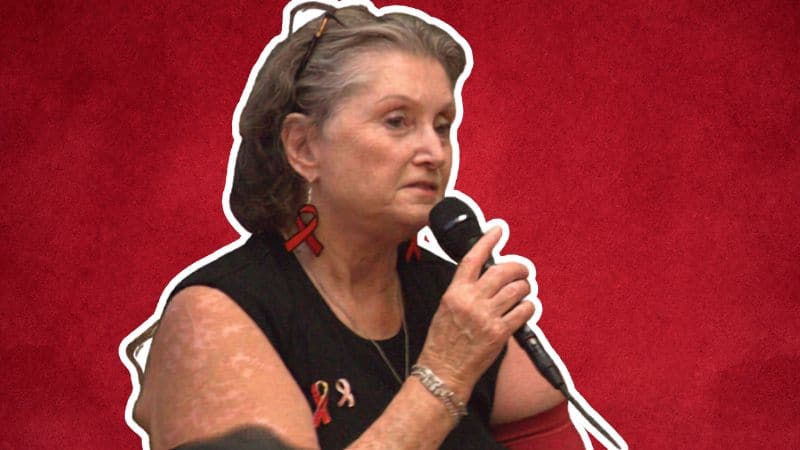
Diane Lloyd has been a prominent voice for women living with HIV over many decades. This year marks 40 years since she was first diagnosed with the virus.
“It’s quite unusual really for somebody like myself still to be around, and there’s not a lot of us,” Lloyd says as she reflects on decades of advocacy alongside her own personal journey.

“It is very different now from when we were first diagnosed, and we were losing a lot of people. I lost my partner in 1992. We weren’t together at the time, and it had been hard to break up with him because you think to yourself, ‘Who else will want me?’” Lloyd shares.
Today HIV is a chronic illness with effective treatments available for most people. Lloyd has seen the landscape of HIV transform over the decades, but one constant is that women living with HIV are often left out of important conversations.
For women with HIV in the early days of the epidemic, the focus was overwhelmingly on whether they should—or should not—have children. Lloyd recalls receiving many mixed messages.
“Having children was the big issue. On one hand, they were telling me about the risk of mother‑to‑baby transmission, but on the other hand they were telling me not to have children. So, well, can I or can’t I?” she recalls. “They didn’t do it openly, but you were very stigmatised and judged if you did choose to have children.”
Today the situation is remarkably different, with less than a two per cent chance of HIV being transmitted during childbirth when the mother is on effective treatment and viral load is suppressed. The World Health Organization recognises 20 countries around the globe that have achieved elimination of mother‑to‑child transmission. The most recent country to reach the milestone was The Bahamas, with its success announced last week.
In Australia, children diagnosed with HIV are usually not born here, but it remains an issue affecting some new immigrants. Through her work with the National Association of People with HIV Australia (NAPWHA), Lloyd has spent years working behind the scenes to ensure women receive clear information so they can make informed choices, particularly around breastfeeding.
“I don’t even know the last time a baby was born with HIV. So any children that have got it normally come from overseas. The National Network of Women, which is under NAPWHA, has done a lot of work over the years with the Nursing Association and the Nursing Association in the UK about women being able to breastfeed. We’re waiting for the World Health Organization to put the okay on it,” Lloyd said.
Despite years of work to reduce discrimination and stigma, Lloyd says it is still a regular experience in her life. She is most frustrated when it occurs in health settings, where people should be better informed.
A few years ago she faced an additional health challenge when she was diagnosed with breast cancer. While undergoing radiation treatment, she noticed that the personal information of the next patient appeared on a screen while she was still in the treatment space.
Lloyd looked over at her own information and realised that it publicly displayed her HIV status and included an instruction to staff to “wear gloves” while treating her. She wondered whether the hospital had a habit of inadvertently releasing personal information as they pushed clients through the treatment process.
“I’m very open about my status, but that doesn’t mean everyone is,” she said. But the instruction about the need for gloves was also concerning.
“When I saw that, I said to the nurses, ‘Look, I know you’re only doing what you’re told, but why do you need to wear gloves?’”
When staff asked if she’d like to make a complaint, Lloyd declined. Instead, she offered to volunteer her time to provide additional training on what reasonable precautions against HIV transmission look like today.
After she finished her treatment and was no longer a patient of the hospital, Lloyd returned to a room packed with medical professionals eager to learn more.
“It was quite a good, interesting experience, and I was really impressed that they got me in and that they changed things,” she said.

As Australia heads towards its goal of virtual elimination of HIV by 2030, Diane Lloyd sees several barriers and challenges ahead. The loss of experienced staff from the HIV sector during the COVID pandemic has been a setback, and maintaining awareness about HIV is an ever‑increasing challenge.
“It was starting to get off the radar before COVID, but people just don’t hear about HIV anymore. Even on World AIDS Day, people just don’t hear about it. They don’t know about it,” she laments.
“They know about the Grim Reaper,” Lloyd notes, referencing the infamous HIV campaign that briefly ran in 1987. “For the elimination of HIV—especially for women, but not just women, also the Aboriginal community and heterosexual people—the reality is they still don’t know about HIV, and that it’s an issue for them.”
Diane Lloyd says new ideas that make HIV testing a routine part of regular health check‑ups should be encouraged.
“When you’re doing your yearly Pap smears and all that sort of thing, getting an HIV test could be included—something that you opt out of.”
Lloyd says more regular opportunities for testing would help address the challenge of women often being among those diagnosed late, not realising they have the virus until it has begun to take a significant toll on their bodies.
“Women may not know their partner is bisexual or has the occasional fling or whatever. Also, there are people flying over to places like Thailand with the higher risk with sex workers.
“They might have injected drugs once when they were 17 and they’re now 30 or so. And when the doctor says, ‘Did you ever use drugs?’ they say no, because in their mind they’re telling the truth—they’ve kind of forgotten about it. It was only that one time or a couple of times in their youth.”
Education campaigns and normalising testing are two elements Lloyd nominates as essential tools in traversing the last mile of the HIV journey, but she acknowledges that both would require significant funding support.
“I’ve always been open about being HIV‑positive and public about it,” Lloyd said. “I’ve got to be the voice for those who can’t speak up for whatever reason. It might be because they’ve got children—some of the women are very closeted about their HIV status. And so for those people, you need somebody that’s got the voice, on everybody’s behalf.
“That’s why I do it, because if you don’t speak up, you can’t educate.”

The phrase “The Last Mile” grew out of the telecommunications industry, where it was discovered that connecting individual properties to networks was the most challenging task.
In 2024 the Australian government launched the Ninth National HIV Strategy with Health Minister Mark Butler restating Australia’s commitment to eliminate blood borne viruses and sexually transmitted infections by 2030.
In the journey toward ending HIV, Australia is now looking down its own Last Mile — which is why we’ve adopted the phrase for this new series of reports exploring how the goals of 2030 can be achieved.
This is a Solutions‑Based Journalism project. The goal is to interrogate the challenge, explore the data, hear the stories and experiences, and present the ideas and practices that will hopefully help us reach the 2030 targets.
Contact
Graeme Watson
Co-editor
graeme@outinperth.com