

The taxi’s exhaust spewed out litres of oil and left its mark on the powder white snow as it headed back down the granite mountain.

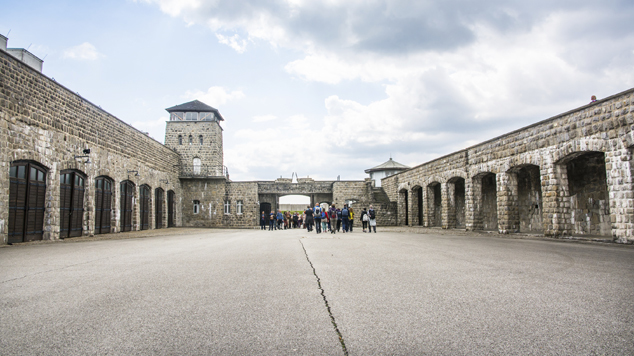
My sneakers struggled to hold a footing as I lumbered clumsily towards the towering entrance that had greeted so many, so many years before. For I had arrived in this snow-covered landscape called Mauthausen-Gusen concentration camp in Austria, the only concentration camp in Hitler’s birth nation.
Built like a medieval stone fortress with a since-destroyed Nazi swastika over the massive iron gated entrance, this would have been a most terrifying sight for anyone who entered. Many who made this perilous journey up the long winding road to the camp wore the pink triangle.
On September 9th 1939, six days after war was declared, the first group of Austrian homosexuals were shipped to the newly-established camp, near Linz. The camp was taken over by the Red Cross on 23rd April 1945, after a six year reign of hell on earth.
You can’t see the infamous granite stairway until you’ve passed the fading painted wooden barracks. 187 irregularly spaced steps lead from the granite stone pit below to the other building projects above. It was called the “Stairs to Death”.
In double time the prisoners had to carry heavy stones on their backs, those who could not keep pace were kicked back down the steps by guards taking other prisoners with them. If a prisoner got to the top of the stairs without his stone, the SS guards took him to the edge and shoved him off the “Parachute Wall” to his death. Hanging corpses were another reminder that failure to complete the stairs was not an option.
Every generation suffers, but the barbarity unleashed by the Third Reich on its own population and that of the occupied territory was on an unprecedented scale. When the war was entering its final phase in 1944 a lot of material was destroyed and so it’s difficult to give a definitive figure on the exact numbers of those who wore the Pink Triangle. Historians estimate 50,000 to 63,000, of which nearly 4,000 were juveniles, were convicted of homosexuality under Paragraph 175a in the years 1933-1944. Also recorded were the arrests of six lesbians.
In Richard Plant’s ground-breaking book, the Pink Triangle, he states that at the time of liberation of camps in 1945: 60% were dead; 26% liberated; and 13% were discharged. According to German law, homosexual ex-prisoners were to be treated as criminals, with some American and British jurists of the liberation armies, on learning that an inmate had been put into a camp for being homosexual, ruled that a camp did not constitute a prison. Therefore, if someone had been sentenced to six years in a prison, had spent three years in jail and three years in a camp, the he still had to finish the sentence in jail after liberation.
Paragraph 175 was repealed in 1969. No Pink Triangle inmates are alive today, the last Rudolf Brazda died in 2011 aged 98.
2015 is a year in memory: of the fallen Anzacs 100 years ago, and the end of the WW11 70 years ago. I feel that it’s especially important to remember those who lost their lives in such a harsh landscape as Mauthausen and other Nazi death camps and that they never fade from history. The brave men of the Pink Triangle will remain in my collective thoughts for years to come.
Terry Larder
Image: Concentration Camp of Mauthausen, May 10, 2014

You can support our work by subscribing to our Patreon
or contributing to our GoFundMe campaign.