

An Albany councillor who raised concerns during a council meeting about whether LGBTQIA+ communities included “minor attracted persons” has successfully appealed to the State Administrative Tribunal to rescind an order from fellow councillors requiring him to undertake diversity training.
Dr Thomas Brough asked the question during a council meeting in early 2024. It was raised during a discussion about the City of Albany’s support for the Albany Pride Festival and led to multiple complaints alleging the comments were homophobic.

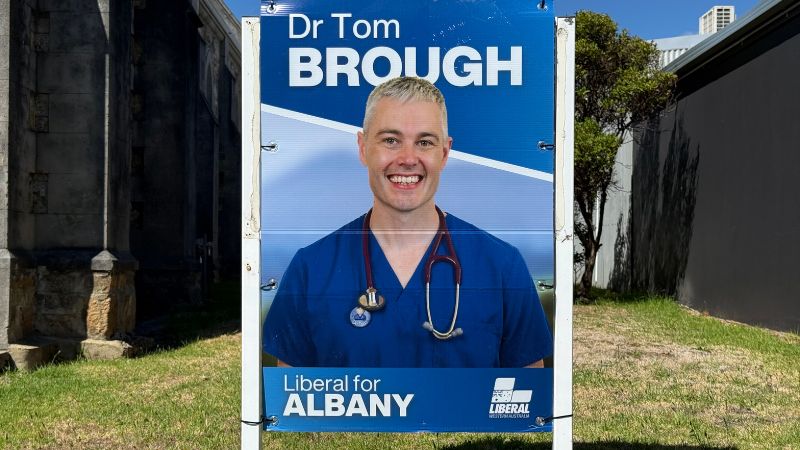
Councillor Brough later said he was relaying a question raised by unnamed constituents who had expressed concerns. His colleagues formally called for him to complete the Australian Human Rights Commission’s Respectful and Inclusive Workplace Training. Dr Brough compared the requirement to undertake the training with conversion therapy and took the matter to the State Administrative Tribunal.
The tribunal has now ruled in his favour, finding he is no longer required to undertake the training and that the council erred in treating his comments as a breach of its Code of Conduct.
Earlier this year, Cr Brough told the council that while he had not completed the training, it no longer existed after being removed by the Australian Human Rights Commission. Councillors did not require him to undertake an alternative program.
The original comments attracted national attention and increased Dr Brough’s public profile. He was selected as the Liberal Party candidate for the 2025 state election, but was unsuccessful. He was later re-elected to the City of Albany Council.
Rights group Just.Equal has described the case as another example of how Western Australia’s laws fall short in protecting people, particularly members of LGBTQIA+ communities. Spokesperson Brian Greig said legislative reform was needed.
“This incident shows clearly why the state needs effective anti-vilification laws. It really doesn’t matter if Dr Brough rejects LGBTQIA+ sensitivity training. Clearly that would be pointless. What matters is that in WA, if people allege that LGBTQIA+ people are inclusive of paedophiles, there is no civil remedy against such harmful speech.
“Incitement to hatred laws alone would be ineffective in this situation, as trying to prove criminal intent would be impossible. The only solution is to have a subsection of state-based hate speech laws that deal with intimidation, humiliation, ridicule and insult,” Greig said.
“This is how it’s done in Tasmania, which has the nation’s strongest and most effective laws in this area.
“The wording in Tasmania’s hate speech law is taken directly from Section 18C of the federal Racial Discrimination Act and has been in place since 1998,” Greig said.
“State Attorney-General Tony Buti has flagged hate speech laws by the end of this year, but he has not said whether the Cook Government’s bill will include anti-vilification provisions or be as effective as Tasmania’s laws, which are the national gold standard,” he added.
Earlier in 2026, Attorney-General Tony Buti described Western Australia’s new Equal Opportunity legislation as being only “a few months” away. More recent comments have committed the government only to introducing the bill before the end of 2026.
At a recent event in Perth, staff from the Equal Opportunity Commission said they had been advocating for legislative reform for almost a quarter of a century.