


As the audience poured out of the Heath Ledger Theatre after the opening night performance of The Shepherd’s Hut, the discussion of what they had watched over the last 80 minutes was dichotomous.
Half had just stood to give a standing ovation, praising the theatrical adaptation of Tim Winton’s novel. The other half were less impressed. The room, filled with regular theatre-goers, was polarised, a perplexing result.

While Winton’s writing often makes the landscape of Western Australia a significant element of his storytelling, this adaptation from playwright Tim McGarry, director Matt Edgerton, and set designer Bruce McKinven keeps things simple. The stage is filled with plain white sand, a large backdrop used for video projection, and bold lighting shining down on the performers.
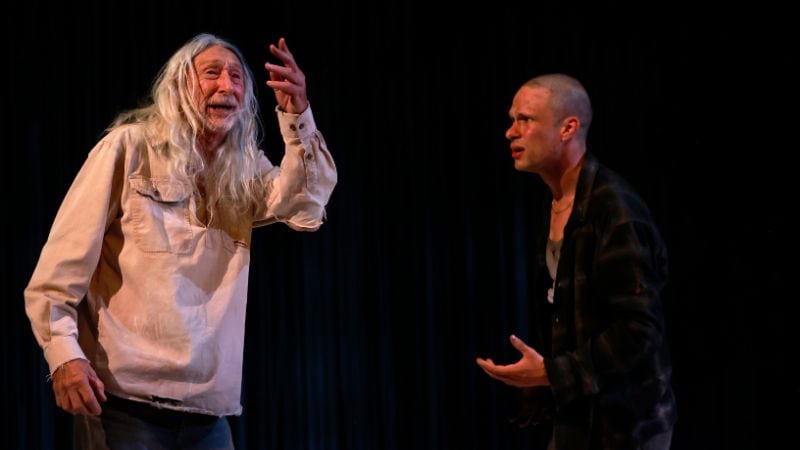
The simplicity of the staging puts all our attention on the four performers who bring the story to life. Their performances colour in the landscape – low-lying scrub, a salt lake, a dilapidated hut, blazing sun. None of it is there, but I could imagine it all.
Our tale brings together Jaxie Clackton, a teenager running from his home in a remote town. As he ventures deep into the desolate landscape, he comes across Fintan MacGillis, a disgraced Irish priest living alone in exile. Ryan Hodson delivers a strong performance as the teenager, and Black Swan stalwart George Shevtsov is compelling as the priest jettisoned to the edge of the world.
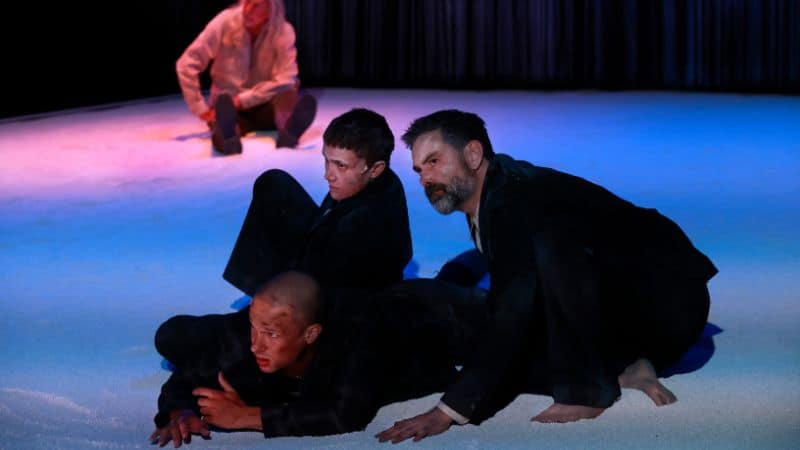
Joining them on stage are Ella Prince and Ben Mortley, who form a Greek chorus of two to narrate the work, combined with a physical performance that conveys emotion and motivation. It is a device that delivers a distinctly theatrical experience. At a time when many stage productions come across like television scripts acted out on stage, this is pure theatre. At the same time, it seems Winton’s story has a great deal that needs to be told to us, suggesting it may not be ideally suited to stage adaptation.
The performances are powerful, sharing a story of two men at different points on the age spectrum, with contrasting views on life, slowly finding a way to connect, while both battle bigger demons. For a long time it seems while there’s a lot of back and forth, but not a lot is happening. Then the conclusion, which is compelling, happens quickly.
The Shepherd’s Hut might make you think about masculinity, trauma, connection and truth. It might make you consider what happens to those expelled from our lives, or equally it might make you wonder how long before the show is over. It doesn’t speak to everyone, but it certainly has something to say.