


Fanny Lye Deliver’d | Dir: Thomas Clay | ★ ★ ★ ★ ★

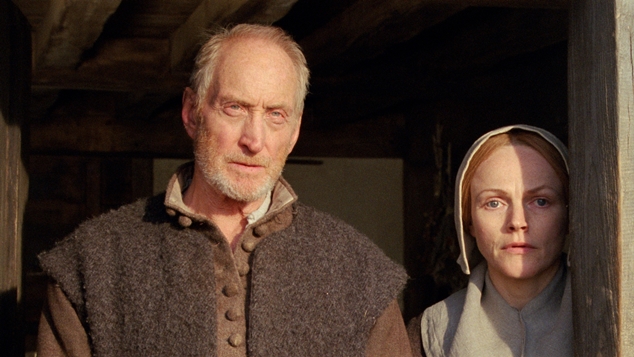
It is 1657 and Fanny Lye (Maxine Peake) lives on a remote Shropshire farm in a simple thatched cottage with her husband John (Charles Dance) and young son Arthur (Zak Adams). Surrounded by mud and continually shrouded in mist and smoke, the cottage becomes the centre of a battle for opposing beliefs.
It is six years after the English Civil War; Oliver Cromwell now presides over a divided England with Puritanism and Non-conformism at opposite ends of the ideological spectrum. Fanny’s Puritan household is ruled by her husband who is quite a bit older than her and has learned how to discipline from his time in the military.
When Thomas (Freddie Fox) and Rebecca (Tanya Reynolds) turn up to their abode seeking sanctuary from pursuing lawmakers, their talk of sexual equality and democracy upsets the rigid patriarchal hold that John has held over Fanny. In the claustrophobic confines of the farmhouse, Fanny watches as the power play between her husband and the radical dissenters ropes her in and implodes her world.
Writer and director Thomas Clay has categorized his film as a Western set in the 17th century and the inside–looking-out shots are reminiscent of classic Western films like High Noon. When the domestic rivalry is interrupted by the High Sheriff and his deputy looking for the runaways, it is obvious that there is an even bigger threat to the people in the house beneath the thin veneer of rather camp manners.
Based on the real Fanny Lye, whose determination to find a better way to live is recorded in history, the drama does not hold back on the brutal violence that served those who considered themselves to be the most righteous.
With a set built for the film, costumes hand-stitched using materials from a re-enactment society and music made from instruments of the time, the drama is full of authenticity as it takes the audience back to the time when Fanny Lye found her voice to leave a continuing legacy.
Lezly Herbert

You can support our work by subscribing to our Patreon
or contributing to our GoFundMe campaign.