

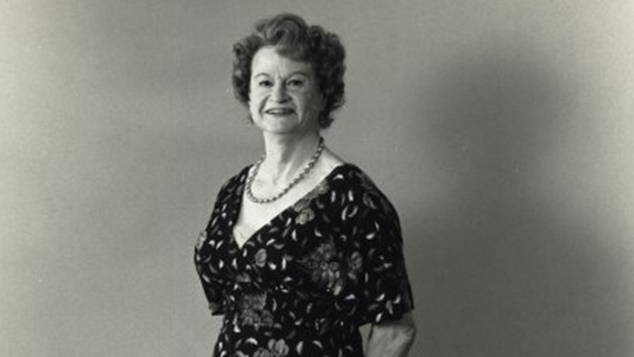
Virginia Prince was a pioneer for transgender recognition
Born in Los Angeles, California, in 1912, Virginia Prince was assigned male at birth.
From the age of 12 she often dressed in women’s clothes and began presenting as feminine in public. When she was 18, she attended a church Halloween party as a woman and won first prize in the competition for “best costume”.

After training as a pharmacist, she married and had a son, but the relationship did not last. Her family were shocked when her divorce papers cited “transvestitism” — the term of the time — as the grounds for the divorce.
After consulting a psychiatrist, who advised her to embrace the desire and accept who she was, Prince became more comfortable with her gender.
In 1960 she began publishing the magazine Transvestia. She launched the project by asking 25 friends to donate $4 each to cover the start‑up costs.
Sold by mail order and through adult bookstores, Transvestia was published bi‑monthly, and 100 issues were produced between 1960 and 1980. The magazine attracted readers from around the world.
Through the magazine she forcefully rejected the notion of the time that people like her were “disturbed”, and she was at the forefront of using the term transgender.
However, by the 1970s she was criticised for her promotion of traditional family values and societal norms. She argued that homosexuals and people who treated gender as a fetish were not aligned with her views.
She passed away in 2009 in Los Angeles.
Footballer Justin Fashanu died in 1998
Justin Fashanu was an English football player who played for a variety of clubs between 1978 and 1997. He is remembered as the first top‑level footballer to publicly come out as gay, and as one of the first players to command a transfer fee of more than £1 million.
Fashanu was the son of a Nigerian barrister living in the UK and a nurse from Guyana. When his parents split up, he and his brother were sent to live in a care home. They were later fostered by a British couple.
He found success in football playing for Norwich from 1978. In 1981 he was transferred to Nottingham Forest, becoming the first Black footballer to attract a £1 million transfer fee. In his autobiography he shared that in the early 1980s his management discovered he had been visiting gay clubs, which led to a period of turmoil that affected his on‑field performance.
He went on to play for a wide range of clubs in the UK, the United States and Canada. In 1990 he came out publicly in a newspaper interview and spoke about how most of his fellow players were generally accepting of his sexual orientation, though they often made jokes at his expense. He continued to play for clubs around the world until 1997.
In 1998 Fashanu was accused of sexually assaulting a 17‑year‑old in Maryland. At the time, homosexual acts were illegal in the US state. He was questioned by police but released from custody. When police came to arrest him, he had already fled back to the United Kingdom.
He died by suicide on 2 May. He left a note explaining that, based on his interactions with police, he felt there was no possibility he would receive a fair trial in the United States, and that the charges could have resulted in a 20‑year prison sentence.
His life was brought to the screen in the 2017 Netflix film Forbidden Games: The Justin Fashanu Story.
Do you need support?
If you are struggling with anxiety or depression, support and counselling are available from:
QLife: 1800 184 527 / qlife.org.au
QLife are a counselling and referral service for LGBTQIA+ people.
DISCHARGED: info@discharged.asn.au / discharged.asn.au
Discharged is a trans-led support service with peer support groups for trans and gender diverse folks.
Beyondblue: 1300 22 4636 / www.beyondblue.org.au
Lifeline: 13 11 14 / lifeline.org.au
Image of Virginia Prince: copyright University of Victoria Libraries published under a CC BY-SA 4.0 license.
This post was first published in 2021 and has been subsequently updated.