


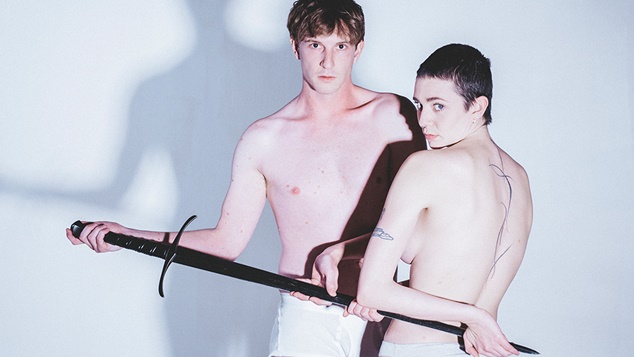
Salome δ | Summer Nights at The Blue Room | Until 5th Feb | ★ ★ ★ ★ ★
Sickness and ill-health are ever-present today. They consume every news cycle. We’ve been living with the reality of Covid for exactly two years. And as Omicron makes itself present on a local scale, more and more of us have become hyper-vigilant for the safety of ourselves, our loved ones and our community. It’s only just then that our creatives discuss this in their work, opening the discussion to include other forms of illness, other viruses.
Salome δ is a dance-theatre work about illness. Yes, it explores the current Covid landscape, but it delves deeper. This is a show about being HIV+, about anorexia, about mental health. But it’s also a show about dancing, theory, recovery and being a little bit of uWu. It is a show that brings us the head of troubles… only to reveal it is still attached to the body of our own resilience.
Inspired by the biblical dance of Salome (think “seven veils”), Salome δ has been created by dance-maker Olivia Hendry and theatre makers Andrew Sutherland and Joe Paradise Lui. The show starts at a ferocious pace as autobiography crashes and melds – effortlessly – with the theory of Susan Sontag and instructional notes from Jonathan Burrows’ choreography handbook. The result is almost frenzied, matched by music and video projections that scrape and jitter. It does ease into moments of clarity when Covid is discussed, only to pick back up.
It’s these autobiographical monologues that are most captivating. Here, seroconversion is described and explained in such a raw and honest manner. Anorexia is discussed with frankness. These two topics in particular are spoken of and managed in such an open way that I found myself wanting to applaud, loudly, each time they brought up – Sutherland and Hendry should be commended for sharing such parts of themselves in such an epic manner.
To be honest, the end of Salome δ came as a surprise at the time. In a work laden with intensity, one might expect it to end in a similar, brutal fashion. But instead, we are offered the opposite. We are offered tenderness, trust and rest, such crucial elements of illness that are sometimes overlooked – we’re happier to discuss the symptomatic terror rather than the sustained living with, or the blissful easing back into wellness.
At the end of Salome δ, we are offered compliments and care. And perhaps that in itself is a brutal ending – so few of us are happy inside our own sickness that “light” seems an abstract concept. To take it further: many of us have been brought the head of troubles, and are trapped within said head, when what we really need are the body and the heart to manage and helps us carry our pain, our unease.
I’ve seen many works Andrew Sutherland has been involved with, and to be honest, this is my favourite to date. The tone ranges from anger to camp, to wistful and broken with dexterity and aplomb. Olivia Hendry’s dance work creates such vivid tension, complimented by the brilliantly nuanced costume design of Declan MacPhail.
Salome δ is layered, profoundly so, and it captures the abject and viral with astounding reverence. I know it’s a tough time to be going out to see theatre, but I strongly encourage people to catch Salome δ if you can: it’s truly infectious. But more than that, Salome δ is necessary medicine.
See Salome δ until 5th of February at The Blue Room. For tickets and more information head to fringeworld.com.au or The Blue Room.
Scott-Patrick Mitchell (SPM) is a non-binary performance poet and writer with over 20 years review experience. SPM appears in Contemporary Australian Poetry, won the 2019 Wollongong Short Story Prize and has created such stage works as The 24 Hour Performance Poem.

You can support our work by subscribing to our Patreon
or contributing to our GoFundMe campaign.