

OPINION
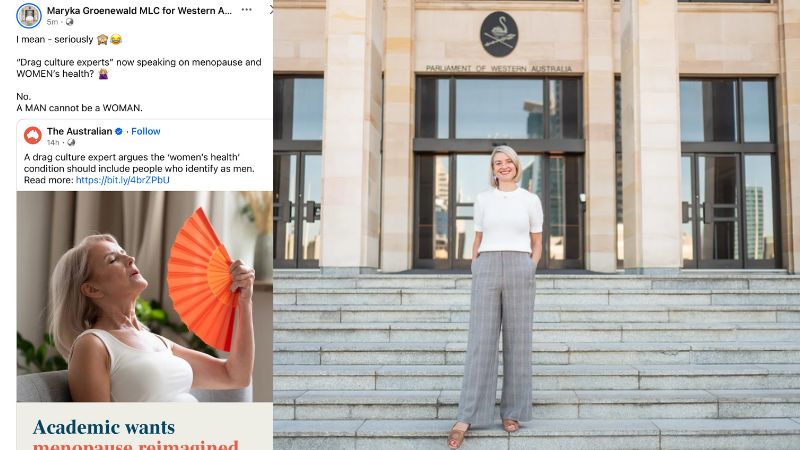
“A drag culture expert argues the ‘women’s health’ condition should include people who identify as men,” The Australian’s social media post declared this week, promoting an article about an upcoming seminar advocating for a more inclusive approach to public health campaigns about menopause.
The national newspaper shone a spotlight on Dr Kerryn Drysdale, a senior research fellow at the University of New South Wales’ Centre for Social Research in Health.

The article was triggered by an online seminar to be held next month, which will discuss how education and awareness about menopause can reach all people it affects — including transgender men and gender diverse people.
While describing Dr Drysdale as a “drag culture expert” is not inaccurate — she did complete her PhD research in that area — it ignores the significant amount of health‑promotion research she has undertaken over the last decade.
“While it is indeed correct that I am an expert in Australian drag cultures, this related to my PhD research 10 years ago. Since then, I have been working in a research centre renowned for its high‑quality research into the social determinants of health and responding to inequities in health,” Dr Drysdale told OUTinPerth.
“My research on the experiences and expectations of menopause among trans and gender diverse people is aligned with this focus on addressing health inequities.
“Like many other aspects of health, including trans and gender diverse people in a conversation does not detract from the barriers and enablers for cisgender women to access much‑needed health care and information related to their own experiences of menopause. Looking to outlier or non‑normative aspects of menopause beyond biological ageing at midlife can only benefit all people with ovaries who may experience this life‑course event,” Dr Drysdale said.
By framing Dr Drysdale as a “drag culture expert” rather than the more accurate descriptor — a leading researcher in health promotion and health inequality — The Australian is blowing the dog whistle to the anti‑trans brigade.
That call was quickly taken up by first‑term Western Australian MP Maryka Groenewald. Since joining parliament, the Australian Christians leader has made campaigning against trans people one of her top priorities.
In a Facebook post, Groenewald reacted to the suggestion that health policy might be influenced by someone with expertise in drag culture.
“I mean seriously,” she wrote, alongside emoji of a monkey covering its eyes and a laughing face. “‘Drag culture experts’ now speaking on menopause and WOMEN’s health?” She then added, “No. A MAN cannot be a WOMAN.”
You have to wonder whether Groenewald actually read the article. The seminar is discussing how transgender men and gender diverse people can be included in the conversation — and the same logic applies to transgender women in other health contexts.
Underneath her post, followers suggested Dr Drysdale’s qualifications were likely only “honorary,” others called for her resignation, and one commenter even suggested thermonuclear war as the answer.
A friend of mine, who is a transgender man, shared a few years ago that his doctor had suggested it might be time to check his prostate now that he was over fifty. With one in six men in Australia likely to develop prostate cancer before the age of 85, his doctor was being proactive.
I asked how his doctor could be unaware of his gender history, and he noted he’d only ever visited that clinic for a cold. He joked that he had considered letting the doctor attempt the test.
In 2024 the Rainbow Realities Report from La Trobe University, that was commissioned by the Commonwealth Department of Health and Aged Care highlighted that there are significant gaps in engagement with health care among the LGBTIQA+ cohorts.
It also found that reproductive health is an area where the disparities are even more pronounced.
“Disparities in the sexual and reproductive health of LGBTQA+ populations, more so than other domains of health, are shaped by the stigma affixed to sexual and gender diverse populations, and sexual practices that fall outside the bounds of heteronormativity.” the report noted.
In many areas of health care, significant groups face barriers to the support they need. Men who have experienced sexual assault may resist using services if they are fully embedded within women’s health settings.
As Australia works towards the goal of virtually eliminating HIV by 2030, one of the hardest‑to‑reach groups is men who have sex with men but do not identify as gay or bisexual. Men from religious backgrounds, Indigenous Australians, and new immigrants are also at higher risk, meaning messaging must be tailored to reach these specific groups.
Preventative health saves governments considerable money, it’s a worthy investment than is preferable to the costs of treating people for conditions which is almost always much more expensive in the long run.
But more importantly – it is only by being inclusive, removing barriers, listening to people with lived experience and taking information to the people who need it that meaningful results will be achieved — transgender men and gender diverse people deserve clear access to services and information about menopause.
Sam Gibbings, CEO of Transfolk WA, said it was disappointing that Groenewald was putting an ideological agenda over people’s health needs.
“It is deeply disappointing to see a Member of Parliament prioritise an ideological agenda over the health needs of Western Australians. She is misrepresenting a health seminar and manufacturing a culture war out of a basic medical requirement.
“None of us chose the bodies that we are born into, and we all deserve to be adequately educated about our bodies, so that we can care for them better.” Gibbings said.
“This isn’t about redefining womanhood. It’s about ensuring everyone who experiences menopause, including trans men and non-binary people, has the health literacy they need to manage their own bodies.
“To suggest that providing medical information is an attack on others is a dangerous distortion of public health. We need leaders who lead with evidence and empathy, not those who using dog-whistling to create barriers to essential healthcare.” Gibbings said.
OUTinPerth reached out to Maryka Groenewald multiple times but received no response.