

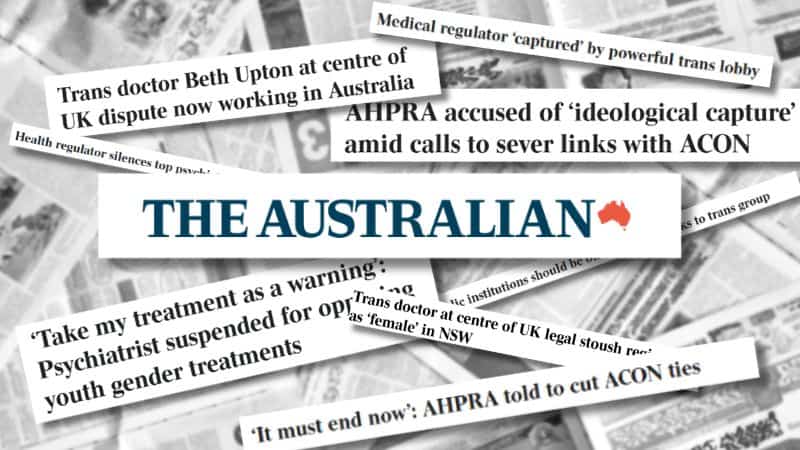
Australia’s health practitioner regulator has hit back at a series of articles from The Australian newspaper, saying the reporting has the potential to undermine its important role.
In recent weeks the newspaper has published multiple articles criticising Ahpra’s decision to place limitations on psychologist Dr Andrew Amos, a prominent opponent of the gender‑affirming care model for people experiencing gender dysphoria. Dr Amos has also spoken out against bans on conversion‑therapy practices.

The newspaper has further criticised the regulator for not listing transgender health professionals under their birth gender. Several reports have focused on Dr Beth Upton, who was previously at the centre of a discrimination case in the United Kingdom.
The media outlet has also described Ahpra as being “ideologically captured” by a pro‑transgender ideology through its relationship with ACON. The reports in The Australian often go on to be amplified by commentators on the Murdoch‑owned TV channel Sky News.
In a detailed statement Justin Untersteine, the CEO of Ahpra, and Dr Susan O’Dwyer, the Chair of the Medical Board of Australia, responded to the barrage of articles.
“The Australian has published a number of articles that have the potential to undermine trust in the role we as regulators play, and so we seek to correct the record.
“We are enormously proud of the work our 153,000 registered medical practitioners do to provide healthcare to Australians. The vast majority never come to the attention of Ahpra or the Medical Board of Australia, and that is because they uphold the professional standards and the Code of Conduct we have set for them,” they said.
The Ahpra leaders said they would continue to have zero tolerance for discriminatory behaviour.
“People from marginalised and minority communities have, sadly, all too often been the recipients of prejudice. They are less likely to seek health care, more likely to experience racism or discrimination when they do, and many have poorer health outcomes compared to the general population. This is why we have zero tolerance for expressions of racism and discrimination by medical practitioners.”
Untersteiner and O’Dwyer said there is a balance between free speech and professional responsibilities.
“Like all Australians, registered health practitioners absolutely have a right to free speech. Ahpra and the Medical Board are committed to the principles of free speech and the right of registered health practitioners to enter into professional and public debates.
“But this right to free speech is constrained if a practitioner comments, or supports comments, that can cause harm to groups or individuals. Typically, the harm pertains to racism and discrimination. If commentary becomes hateful and directed toward specific members of the community, this causes harm.
“The harm is that the commentary erodes trust in the profession as a whole, and some members of the community might fear seeing a medical practitioner and do not access the health care they need,” they said.