


LGBTQIA+ community representatives have applauded the passage of Tasmania’s ban on conversion practices, saying it is the strongest and most comprehensive legislation of its kind in Australia.
The Upper House voted through the Conversion Practices Prohibition Bill with only a minor amendment.

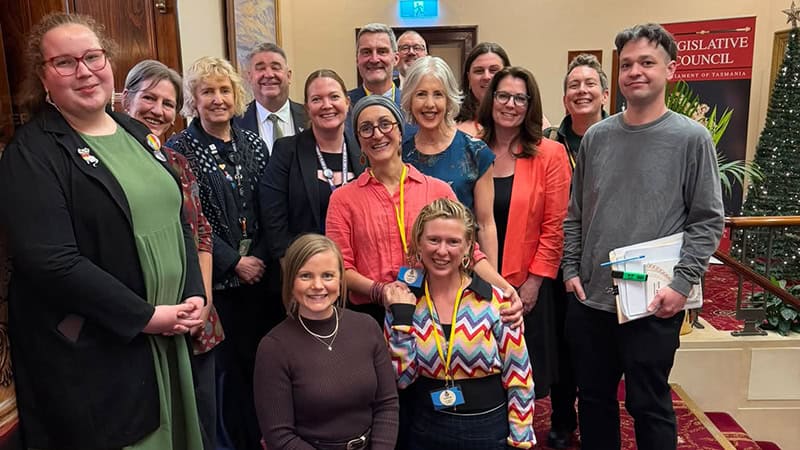
Equality Tasmania spokesperson Rodney Croome paid tribute to Tasmanian conversion survivors, whose advocacy for the ban began a decade ago.
“The conversion ban is a tribute to the bravery of Tasmania’s conversion survivors, whose stories of the harm they experienced have propelled this important reform.
“The ban is the most comprehensive and effective of its kind in Australia, taking Tasmania from one of the last states to ban conversion practices to now having the strongest law.
“I thank the Tasmanian Greens for drafting and introducing it, and all those MPs across all political parties and the crossbench who have supported it.”
Tasmanian conversion survivor advocates were elated by the passage of the bill.
“My hope has always been for young people to feel supported and celebrated for who they are, and never forced to be someone they’re not. The dangerous and dehumanising practice I endured ends now. This is a momentous day for Tasmania,” said Renie Elliot.
Elliot described the conversion facility she attended as “a cross between a psych ward, a barracks and a convent”.
National conversion survivor advocate Nathan Despott said the debate in Tasmania had been heated and prolonged, but that the outcome was Australia’s strongest legislation.
“In no other state has this reform been debated for so long and so heatedly. But the outcome is legislation which sets a new national and global gold standard. I am inspired by the persistence, resilience and achievement of Tasmanian advocates.”
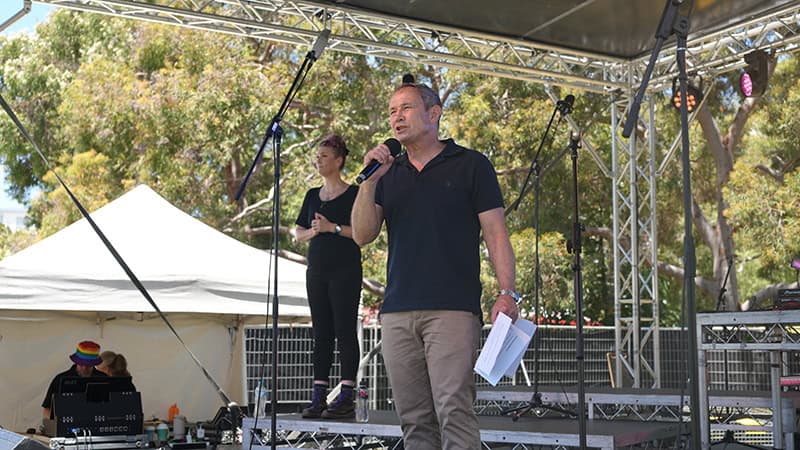
Western Australia and Northern Territory yet to adopt bans
Tasmania joins New South Wales, Victoria, Queensland, South Australia and the ACT in prohibiting conversion practices. Western Australia and the Northern Territory are yet to adopt specific bans.
The Western Australian Government pledged to introduce legislation in 2022 but later said it had run out of time to complete the reforms during its second term in parliament. The government subsequently promised the legislation would be a priority during its third term.
In January, Attorney General Tony Buti said a bill would be introduced into parliament in 2026. However, the legislation has yet to be introduced.
At Fairday 2026, Premier Roger Cook declined to provide a timeline for the legislation, but noted his government had completed surrogacy law reform in 2025 and introduced new Equal Opportunity legislation in 2026.
A government spokesperson later told OUTinPerth that the legislation was still being worked on.
“Work is progressing well on legislation to ban conversion practices and introduce a civil scheme for survivors,” a government spokesperson told OUTinPerth in response to inquiries about when the long-promised bill would be introduced.
“The timing of the bill’s introduction will be a matter for Cabinet.”
Tasmania’s legislation described as a “gold standard”
If the Cook Government introduces legislation, it will have the benefit of being able to examine the approaches adopted elsewhere in Australia.
Tasmania’s laws include a zero-tolerance approach to conversion practices in any form, context or duration. The legislation also allows any person to report alleged conversion practices, rather than limiting complaints to those who directly experienced them.
The legislation establishes an education, prevention and response framework, and empowers officials to conduct investigations, provide targeted education and secure enforceable undertakings. A range of penalties is available, including criminal penalties where injury is inflicted.
Supporters have described the legislation as a “gold standard” because it includes several elements not adopted in all other Australian jurisdictions. These include the creation of a Conversion Practices Commissioner to administer the scheme and a system of enforceable education measures.
The legislation also includes protections for a broad range of people, including asexual, aromantic and agender people, alongside gay, lesbian, bisexual, transgender and gender-diverse people.
It further establishes a positive legal duty on individuals and organisations to prevent conversion practices.
The laws also include mandatory referral obligations requiring key government agencies to notify the Conversion Practices Commissioner of conversion practices.