


In 1991 ‘My Own Private Idaho’ screened at the Venice Film Festival
Director Gus Van Sant had received widespread acclaim for his breakthrough film Drugstore Cowboy.
Drugstore Cowboy was based on the unpublished autobiographical novel by James Fogle. It followed a group of people struggling with addiction who travelled across America, robbing hospitals and pharmacies to support their drug use.

The film featured Matt Dillon, Kelly Lynch and Heather Graham, while writer William S. Burroughs also made an appearance.

Following the success of Drugstore Cowboy, studios were eager to work with Van Sant, and his next film was one that many studios had considered too risky to produce just a few years earlier.
My Own Private Idaho starred River Phoenix and Keanu Reeves as hustlers Mike Waters and Scott Favor. The film’s narrative draws on Shakespeare’s Henry IV, Part 1, Henry IV, Part 2 and Henry V.
Upon its release, the film generated controversy. Some commentators and audiences were surprised to see two of Hollywood’s most prominent young stars portraying male sex workers. While it may seem less controversial today, the film also prompted considerable discussion about its depictions of same-sex relationships and sexuality.
Many of the film’s intimate scenes are presented through a series of stylised black-and-white images. The film was a critical success and became a favourite among arthouse audiences.
When the film marked its 25th anniversary in 2016 OUTinPerth published a reflection on the film from Kyle Kash, who’d just seen it for the first time, and OUTinPerth co-editor Graeme Watson who saw it when it was first released.
In 2024 the film was added to the US Library of Congress after it was judged to be of “cultural, historic or aesthetic importance”.
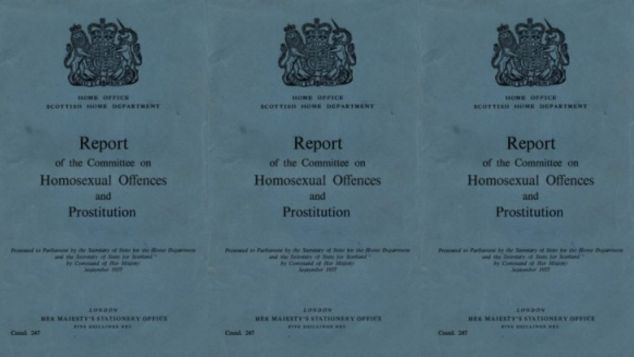
In 1957 the groundbreaking Wolfenden Report was published
In 1957, the groundbreaking Wolfenden Report was published.
The report paved the way for the decriminalisation of homosexuality in Great Britain.
The Wolfenden Committee, formally known as the Departmental Committee on Homosexual Offences and Prostitution, met for the first time in 1954. The group was established by the British government to examine the law and practice relating to homosexuality and prostitution.
The committee was named after its chairman, John Wolfenden, a British educationalist. The committee’s report, published on this day in 1957, marked a significant turning point in the history of LGBT rights in Britain.
The committee was established when homosexuality remained a criminal offence in Britain. Its role was to investigate existing laws, examine how they were applied in practice, and make recommendations for reform. In 1954, there were 1,069 homosexual men in prison in England and Wales, with an average age of 37.
The commissioning of the report was prompted by a high-profile prosecution that saw Edward Montagu-Scott, the 3rd Baron Montagu of Beaulieu, imprisoned alongside his cousin Michael Pitt-Rivers and friend Peter Wildeblood.
The committee heard evidence from a wide range of individuals and organisations, including lawyers, doctors, social workers, religious leaders and representatives of the gay community.
The committee’s final report recommended that consensual homosexual acts between adults in private should no longer be a criminal offence. The report generated significant debate in both the media and Parliament.
The Wolfenden Report had a profound impact on both the law and public attitudes towards homosexuality in Britain. Although its recommendations were not immediately implemented, they helped pave the way for the partial decriminalisation of homosexuality in England and Wales through the Sexual Offences Act 1967.
While legal reforms eventually followed in Britain, many former British colonies around the world continue to retain laws derived from the same colonial legal framework.
In 2002 Jeffrey Eugenides ‘Middlesex’ was published
Middlesex, the Pulitzer Prize-winning novel by American author Jeffrey Eugenides, was published on this day in 2002.
Eugenides drew on elements of his own life and Greek heritage, but the novel is not autobiographical, and he is not intersex. The story follows three generations of a Greek American family whose lives are shaped by the inheritance of a genetic variation, ultimately leading to the experiences of the novel’s intersex narrator, Calliope Stephanides, later known as Cal.
Eugenides was inspired to write the book after feeling dissatisfied with his experience of reading a memoir about intersex life. Middlesex was acclaimed by critics, who named it one of the best books of 2002, and it went on to sell more than four million copies worldwide.
The novel explores themes including identity, rebirth, the American Dream, race relations, ethnicity, nature versus nurture, and family history. It also draws heavily on Greek mythology and storytelling traditions.
Middlesex was included in OUTinPerth’s list of 25 Great LGBTI Books to Read that was published in 2014.
OIP Staff, This report was first published in 2023, AI Technology assisted in its development.