


The first Mardi Gras march took place on this day, Saturday 24 June in 1978, and it was met with police violence.
What is now known as the Sydney Gay and Lesbian Mardi Gras, began its life as Sydney’s contribution to the international Gay Solidarity Celebrations, an event that had grown up as a result of the Stonewall riots in New York in 1969.

Mardi Gras was one of a series of events by the Gay Solidarity Group to promote an upcoming National Homosexual Conference, and offer support to San Francisco’s Gay Freedom Day and its campaign against California State Senator John Brigg’s attempts to stop gay rights supporters teaching in schools.
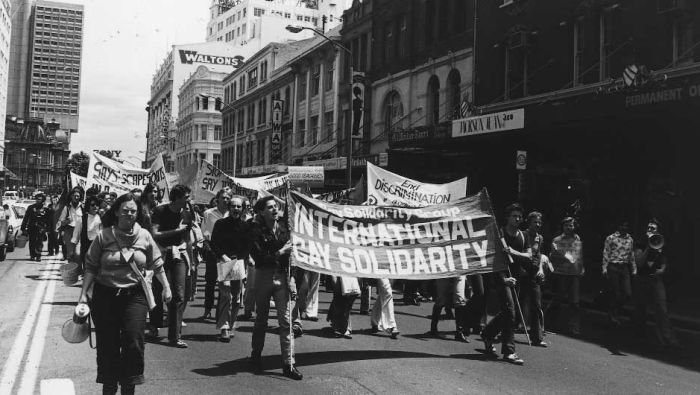
It was also intended to protest the Australian visit of British anti-gay campaigner Mary Whitehouse.
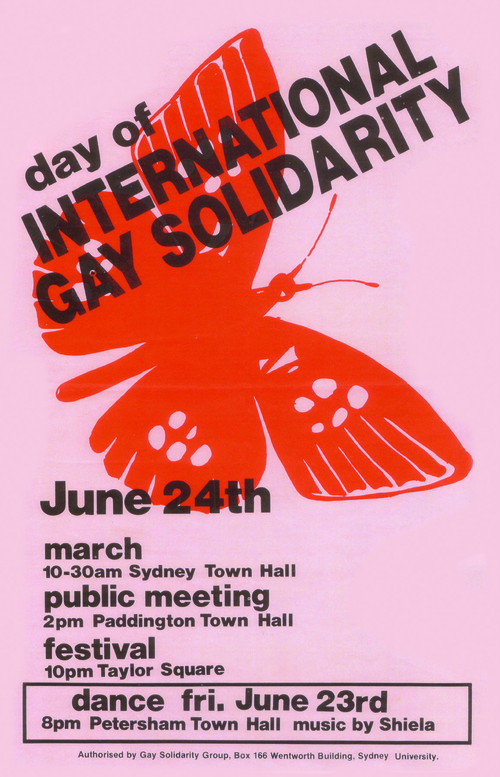
There was a series of events throughout the day, including a march in the morning at Sydney’s Town Hall, public meetings and a second march down Oxford Street in the evening.
Several hundred people from the LGBT community and their supporters gathered at Taylor Square and followed a truck with a small music and sound system down Oxford Street in Darlinghurst to Hyde Park.
The sound system played songs like Tom Robinson’s Glad to be Gay and Meg Christian’s Ode to a Gym Teacher, while the marchers chanted “Out of the Bars and into the Streets”, the political call to action.
As party-goers joined in along Oxford St, the police harassed the lead float along the route and when the march stopped in Hyde Park, where telegrams of support were to be read.
Police confiscated the lead float truck and arrested its driver Lance Gowland.
Angered by this, the crowd which had swelled to 1500 revellers diverted up William St to Darlinghurst Road, where the police had closed the road. At this point the police swooped and violently arrested 53 people, many of whom were beaten in the cells.
The next day the Sydney Morning Herald published the names of all the people arrested, outing many of those involved which led to some of them losing their jobs and being thrown out of their rental homes.
The violent response from police sparked a national debate about LGBT rights and marked a significant change in public attitudes to homosexuality.
Those who took part in the landmark protest are known as the ’78ers and every year they are featured in the Mardi Gras parade, which now takes place in the warmer part of the year. While their numbers fall as the years pass by, it’s always a highlight of the Mardi Gras parade to see them.
In 2016 the Sydney Morning Herald formally apologised for publishing the names of those who took part in the Mardi Gras march and previous protest actions. The NSW Government also passed a motion in parliament apologising for their actions in 1978.
In 2018 the story of the first Mardi Gras was brought to the screen with the television film Riot, which celebrated the event’s 40th anniversary.
This post was first published in 2017 and has been updated.

You can support our work by subscribing to our Patreon
or contributing to our GoFundMe campaign.