

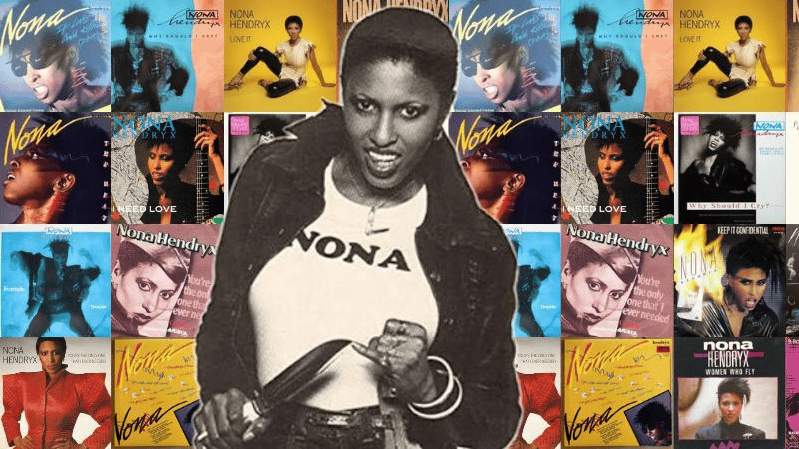
Nona Hendryx rose to fame as a member of LaBelle
Musician Nona Hendryx was born on this day in 1944. Raised in New Jersey, she teamed up with friends Sarah Dash, Patricia Holte, and Sundray Tucker to form the girl group The Ordettes.
When Tucker left the group, she was replaced by Cindy Birdsong and the group renamed itself The Bluebelles. Holte later adopted the stage name Patti LaBelle, and the band evolved into Patti LaBelle and the Bluebelles, scoring its first hit with I Sold My Heart to the Junkman.

In 1967, Birdsong left to join The Supremes and the group changed its name once again, becoming LaBelle. The idea reportedly came from English talent manager Vicki Wickham.
The group worked steadily before achieving its biggest success in 1974 with the album Nightbirds, which featured the smash hit Lady Marmalade. With Hendryx emerging as the group’s principal songwriter, LaBelle continued to enjoy success throughout the 1970s.
When the group split in the late 1970s, Hendryx launched a solo career, releasing albums that explored a wide range of musical styles. She also contributed backing vocals for Talking Heads and wrote songs for artists including Dusty Springfield.
In 1985, Hendryx was among the artists who appeared on the anti-apartheid single Sun City, alongside Bruce Springsteen, Bono, Lou Reed, and many others.
The following years brought some of Hendryx’s greatest commercial success as a solo artist. Her album Female Trouble featured collaborations with Mavis Staples, Peter Gabriel, Prince, George Clinton, and Dan Hartman.
Hendryx has also been an outspoken advocate for LGBTQIA+ communities. In 2001, she discussed being bisexual in a groundbreaking interview with The Advocate magazine.
Her longtime partner is Vicki Wickham. The couple have been together for more than 50 years.

Anna Rüling has been described as the “first known lesbian activist”
In 1904 on this day journalist Anna Rüling gave a speech to the Scientific-Humanitarian Committee in Berlin, the first known public statement of the socio-legal problems faced by lesbians.
Born in 1880, her actual name was Theodora “Theo” Anna Sprüngli. One of the first modern women to come out as homosexual, she has been described as “the first known lesbian activist”.
Born into a middle class family in Hamburg, she originally trained as a violinist, but after she injured her arm she turned to journalism. She began her career with a local newspaper before moving to Berlin where she worked for newspaper magnate August Scherl writing about theatre and music.
In 1904 Rüling was invited to speak at the Scientific-Humanitarian Committee, the world’s first LGBT advocacy group. She delivered a speech Homosexualitat und Frauenbewegung (Homosexuality and the Women’s Movement), where she expressed her view that the lesbian mindset had more in common with men than that of other women. She argued that homosexual people were a third gender, and that lesbian women were more reasonable than heterosexual women and more suited to working in professional roles.
She went on to publish a book of short stories, and continued to write for newspapers. In 1906 she moved to Dusseldorf where she lived for next thirty years. She became a regular contributor to Neue Deutsche Frauenzeitung, a right-wing paper with moderate views on women’s rights.
During the First World War Rüling was an ardent patriotist, nationalist and imperialist. There is no evidence though that she ever joined the Nazi party. In the late 1930’s she moved to Ulm where she worked as a secretary, director and script editor at a local theatre company.
A decade later after World War II she moved again to Delmenhorst, where were continued working in theatre but also resumed her career as a journalist. She died suddenly in 1953, aged 72. At the time of her death she was one of the oldest female journalists in Germany.
OIP Staff, this copyright owner of this image of Anna Ruling is unknown as it used under Fair Use. OIP Staff, this post was first published in 2021 and has subsequently been updated.