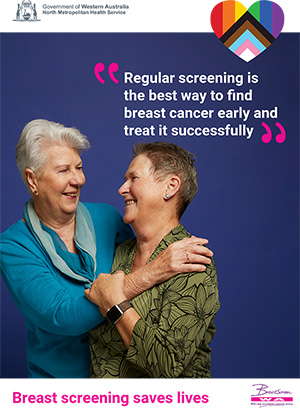


Alyce Schotte talks to OUTinPerth about why she’s signed up to be one of the faces of a new campaign that encourages LGBTIQA+ people to engage with cancer screening programs. The Screening Saves Lives campaign from North Metropolitan Health Service (NMHS) encourages people to get tested for bowel, cervical and breast cancer.
Research has shown that LGBTIQA+ people are less likely than the general population to engage with health professionals, and the result of this is a lower level of early detection illnesses.

As a woman who will soon celebrate her 50th birthday, Alyce Schotte knew that bowel cancer was something she’ll need to be tested for.
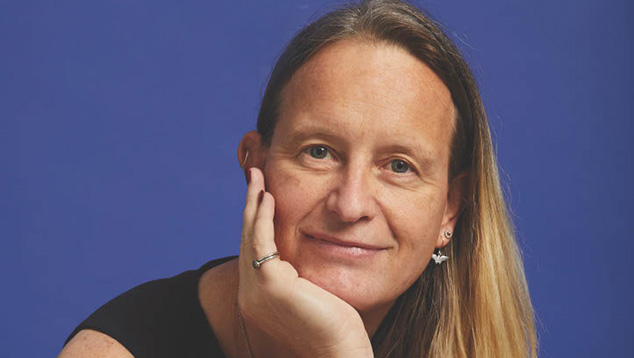
“I turn 50 this year,” Schotte shared during a phone chat on Transgender Day of Visibility. “It’s such a big celebration and everything.”
The LGBTIQA+ rights advocate was aware that this was also the milestone where she would need to start being tested for bowel cancer and consider what other health tests she would also need, moving forward.
All Australians are sent a bowel cancer testing kit in the mail every two years after their 50th birthday.
“A couple of years ago, I was living at a mate’s place, and he was turning 50. He got sent a bowel cancer screening test kit. It was something that arrived in the post, I saw it and asked what it was about.
“So I already had this awareness that at the age of 50, I’m going to get one of these, but what does that actually mean for someone who is transgender diverse? Is it going to be any different in the experience? I had no idea.”
When asked if she’d support the new awareness program, Schotte was eager to be involved because she knew she herself needed more information.
Bowel cancer is the second most common type of internal cancer in Western Australia, following lung cancer. If detected early, more than 90 per cent of bowel cancers can be treated successfully.
Many people experiencing symptoms of bowel cancer put off seeing their doctor because they are embarrassed to discuss their symptoms. Unfortunately, this embarrassment may put your life at risk. It is important to put embarrassment aside and seek advice promptly.
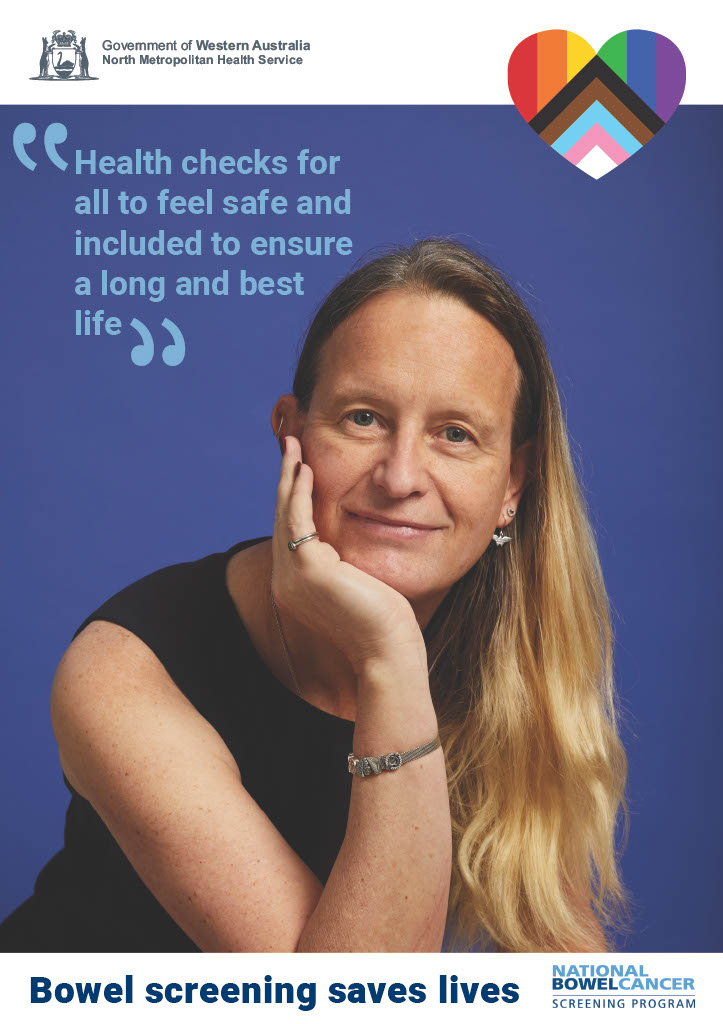
Schotte says the new awareness program for NMHS, that features several members of the local LGBTIQA+ communities, is a great example of health practitioners striving to address the inequality in health outcomes between the queer community and the general population.
While this program is a great example of a proactive approach, Schotte says there’s still a lot of work to be done across the health sector.
“There’s so many pieces and you got to look at where’s the best value for money in that investment to drive change.
“Do we start that at university level where the doctors, the health professionals are being educated so that when they step into the system, they’ve got an idea, they’ve got that visibility and that education to kick off with?
“Or do we need to do it multifaceted, where those who are already doing the healthcare system, whether it’s the administrators, the doctors, the nurses, the admin, whoever it actually is, get a barrel of information and learning at this point now to get them at least starting on their journey?
“I think probably a double barrel approach would be the best. Get both of those things happening. I know there are things happening within some of the education spaces that are shifting the dial for the educators. There’s a term out there called ‘queering the curriculum’, and maybe we need a bit of that into the medical or paramedical sciences.”
Listen to our full chat about creating safe spaces in the health realm, breaking down barriers to connection and access, and embracing regular screenings as you get older.
Find out all the information about bowel cancer and screenings. The three screening programs are continuing to recruit for another photoshoot to continue to represent the WA LGBTIQ+ community in all its diversity, so if anyone is interested they can contact the team via email.
Graeme Watson, This article was created with the support of North Metropolitan Health Services .