

In this post-feminist 21st century, where many women have notably advanced toward equality in society and culture, it’s hard to comprehend why our bodies are such a taboo subject.

Large scale advertising and education campaigns have raised public awareness of prostate and breast cancer while gynaecological conditions such as cancer of the vulva remain relatively unheard of.
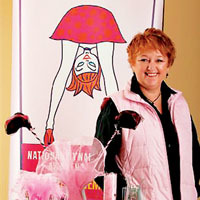
Kath Mazzella, OAM, has been fighting for the recognition of gynaecological cancers and conditions since she underwent a radical vulvectomy in 1994 and discovered a world of myth and secrecy surrounding women’s sexual organs.
‘In the beginning I had an abnormal pap smear,’ she explains.
‘Then I found a lump next to the clitoris and I went to two GPs and two gynaecologists and they said its common, don’t worry about it but it played on my mind and I ended up asking for it to be removed and it turned out to be cancer.’
‘So the doctor put me in hospital and he removed my clitoris, vulva and lymph glands and I was feeling a bit hard about that. Afterwards all I wanted to do was connect with someone who had the same but the systems weren’t in place to allow me to do that.’
While vulva cancer is relatively rare, Kath did eventually hear of and meet other women with similar experiences and that knowledge empowered her to continue exploring the issues nobody seemed to be talking about.
‘The power that came between us was so overwhelming, but I noticed that this power was kept apart,’ said Kath.
‘I’m not talking about power in a bra-burning kinda way; it’s about the power that lies within and being confident.
‘When you go through something like that it’s the aloneness and the separation that is the worst. A lot of this stuff happens behind closed doors and I want the doors flung open.’
One of the main obstacles facing Kath in her efforts to educate and raise awareness of vulvar cancer is women’s surprising lack of knowledge of their own bodies, risks and symptoms and the need for medical professionals to share their knowledge with women.
Many women confuse the vulva with the vagina, which is technically the canal connecting the vulva and the uterus. The word vulva refers to the external parts of a woman’s genitalia including the mons pubis, clitoris, labia majora and labia minora.
‘People ask which part is the vagina and which part is the vulva. Do we know what a penis and a testicle is? Do we have to ask what it is? No.’
‘Why are women living without genitals and dying because we are not giving them this information? But it only belongs to the academics.’
As early detection is vital in the treatment of vulvar cancer, it is important for women to become familiar with their own vulva and be aware of any changes.
‘Prevention is better than cure,’ said Kath.
‘Most women self-examine their breasts regularly, knowing that early detection of breast cancer can be a life saver. Most women don’t realise that their vulva is, also, at risk of cancer.’
In February 2001, Kath founded GAIN, the Gynaecological Awareness Information Network Inc with the aim of creating a support network for women affected by gynaecological conditions.
GAIN has since organised events such as Vulva Awareness Day, Gynaemight forums and International Gynaecological Awareness Day, has petitioned the government on gynaecological issues and works with health and women’s organisations to educate the public.
Kath says being awarded an Order of Australia Medal (OAM) last month and recently being nominated for Australian of the Year has definitely opened some important doors but it is grass-roots awareness that she is really after.
‘I still don’t understand how I can get to this level but I still can’t get the women on the ground level because they’re still socially programmed that you don’t talk about that sort of thing,’ Kath explained.
‘That’s what I want, for the women to come together through the International Gynaecological Awareness Day on the 10th of September and make the biggest loudest noise!’
If you would like to learn more about vulvar cancer, the NSW Cancer Council has extensive information on cause, prevention and treatment.
GAIN can be contacted through their website, which also has information on gynaecological conditions, events and women’s personal stories:
www.gain.org.au
Kath Mazzella is available for public speaking engagements and can be contacted through her website: www.kathmazzella.com
***