

The films of documentary maker Jeffrey Schwarz have appeared in the program of the Revelation Perth International Film Festival many times over the years. He’s made films about drag star Divine, camp film producer Allan Carr, and heartthrob Tab Hunter, just to name a few.
His newest work is Mineshaft: The Cruising Murders, which explores a series of murders in New York in the 1970s that inspired a novel and then the feature film Cruising. But when the Al Pacino thriller was filming in New York in 1979, there were huge protests from the LGBTIQA+ community, concerned about how they would be depicted on screen.

The film has endured, thanks to its status as a staple of video stores in the 1980s. It inspired photographer Robert Mapplethorpe, the TV series American Horror Story has paid homage to it, and it also inspired the film Interior. Leather Bar.
Speaking to OUTinPerth from New York, director Jeffrey Schwarz spoke about why he was intrigued by this 45-year-old movie and the world it spawned from.
Cruising as a film has had such longevity, and it’s a film that we keep talking about and revisiting. What made you want to go look into that 1980s film and the story around it?
Cruising is a notorious movie. I don’t know what it’s like in your neck of the woods, but at least here, this was a movie that came out in 1980. It was directed by William Friedkin. It was a thriller set in the leather world, the sort of underground S&M leather world, and all the bars in the Meatpacking District in New York City.
When the movie came out, it was a murder mystery, and Al Pacino was a cop going undercover, posing as a gay man to try to solve this crime. But the world that it depicted was a fairly realistic depiction of that scene. It also was showing us as murderers and victims, and it was a very violent movie and hugely controversial.
I was 10 or 11 when it came out, so I was too young to see it at the time, but I remember the commercials on TV for it. I remember the radio ads, and I remember seeing news reports on the 5 o’clock news of all the protests. So I was definitely aware of it. It was this notorious movie.
When I came out in the early ’90s, I came out in conjunction with watching lots of movies, and I was obsessed with The Celluloid Closet, the Vito Russo book that talked about gay images in film, and Cruising was a big part of that because it was what they call these days a “bad object”.
You’re not supposed to like this movie because it’s portraying us in a way that is very negative, right at a time when we were looking for positive images because there were so few in the late ’70s and early ’80s. By the time I got around to seeing it, it was the early ’90s, and the film’s reputation was still not great. I think it’s taken time for it to become almost a cult classic because it depicts this vanished world.
The bars that they filmed in, the streets of New York City at that time, the extras who appeared in the film — there’s a real authenticity to it. I was fascinated with the movie, repelled and fascinated at the same time. And I always thought it would make a really fascinating documentary, especially because of the backstory.
This did come out of murders that occurred in New York, and news articles, and then a novel being written. It’s almost like this film has overshadowed the crimes that were actually real.
The film was inspired by a real series of murders in New York City. There were a few different things that were going on. They called them the Bag Murders. There was a series of murders of men whose body parts were discovered tied up in plastic garbage bags and floating in the Hudson River.
There was also the murder of Addison Verrill, who was a reporter for Variety. One night he went to The Mine Shaft, one of the S&M bars in the Meatpacking District, and he met somebody there, took him home, and was murdered in the middle of the night by this person.
Director William Friedkin was fascinated with this whole scene and he thought it would be a great world to depict in a murder mystery. It’s a world most straight audiences had never encountered, right? Then, at the same time, since there were so few movies about gay life, here was a big Hollywood movie by a major director — Friedkin, who’d done The Exorcist and The French Connection — and Al Pacino, one of the biggest stars in the world, making this movie.
This was going to be the first time a lot of audiences were exposed to gay life, and it was not a side of gay life that a lot of gay people wanted to be depicted.
We were trying to mainstream ourselves at that time. We were trying to tell everybody, “Oh, we’re just like you. We’re just like everybody else.”
For me, this is a film that was always in the video store, and I’m growing up in South Hedland on the other side of the planet. There must have been so many people who watched Cruising because of who its director was, and it’s got Al Pacino from The Godfather and Scarface, and suddenly they’re in downtown New York, in a world they never knew existed. For a lot of people, this would have been their first exposure to the gay community.
Also, for gay kids growing up and seeing that movie, that might have been one of their only experiences of seeing gay life portrayed on screen. And depending on your proclivities, either you’re going to be very attracted to it, or you’re going to be horrified. One or the other, or somewhere in between.
I was somewhere in between because of the way that it associated gay sex with murder. It’s essentially a horror film, and in a horror film you’re going to have murder. You’re going to have a murder mystery. You’re going to show the murders, and the murders are depicted so graphically and violently. If you look really closely in those murder scenes, Friedkin and his editor spliced in some flash frames from gay porn movies.
I mean, that is a statement. He’s associating gay sex with death and murder, and linking sexuality with violence.
The film captures New York in 1979. It’s an interesting time, a decade on from Stonewall but before the AIDS crisis. You’ve found footage of the protests that went on while the film was shooting. What do we see?
I’m fascinated with that moment in time. Like you said, it was only 10 years after Stonewall, and the gay community was finding its footing.
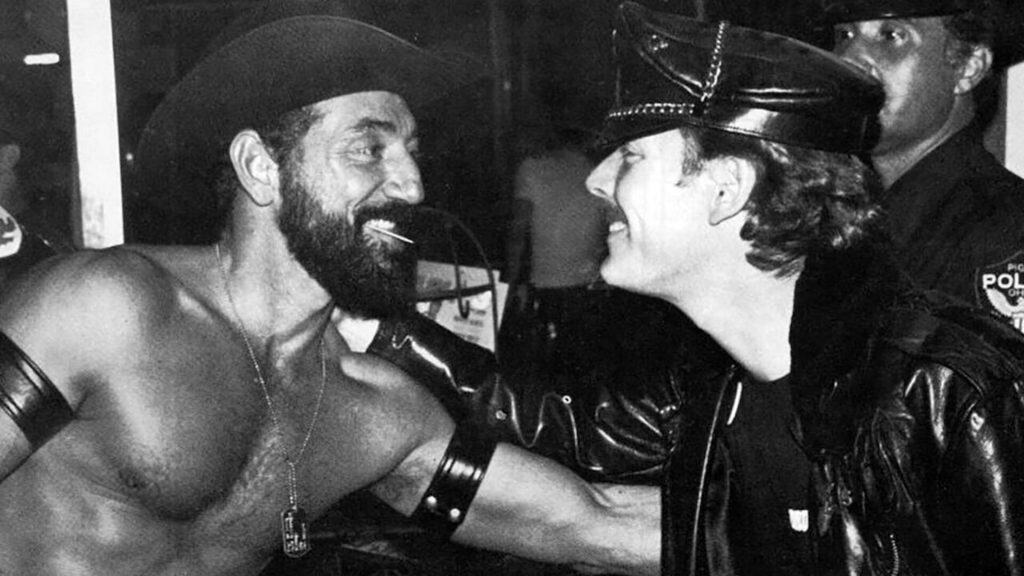
Cruising really focuses on the gay male community at that time. Gay men in New York City were trying to shed the stereotypes of the past. That was a moment in time when a lot of gay guys were beefing up and working out and wearing macho street clothes. There was a thing called the clone look, which was the moustache, the flannel shirt, the keys hanging from your belt, and the leather.
We’re not what they’ve been saying we are all these years. We’re not weak or feminine or sissies. Not that there’s anything wrong with that, but these guys were like, “We are going to be men. We’re going to be macho men,” and the Village People come out of that too.
When we spoke to Felipe Rose from The Village People a few years ago, he described the time as when people were fighting for liberation. Nobody was talking about gay rights or equality — the word was liberation.
Jacques Morali was the gay songwriter and producer who created The Village People, and he was capturing the types of people he saw around Greenwich Village.
In the late ’70s the prevailing attitude was, we’re also going to have sex. We’re going to meet each other on the street. We’re going to cruise each other on the street. We’re going to lock eyes. We’re going to go have sex. We’re going to meet at the bars.
We’re going to meet at the trucks, which were just these trucks lined up near the Hudson River at night that were empty, and guys would crawl into the trucks and have sex.
We’re going to go to the piers. We’re going to meet guys at the piers. We’re basically going to try to shed some of that shame we’ve been carrying all these years and have sex, enjoy it, and have a great time.
That’s some of what Cruising captures, and that’s also the story I was trying to tell in the film. Addison Verrill, whose murder inspired the film, was very much of that generation. He was 36 when he died. He was living in New York and living his best gay life, having a lot of sex, and was partnered at the time too.
That was also an aspect of the relationship where sometimes they would play together. Sometimes Addison would go off on his own and have these adventures. Unfortunately, he picked up the wrong guy, and it ended his life.
That’s always a fear in many gay men’s minds. If you pick somebody up, is it safe? In this case it was not. Most of the time, it’s okay. This time it was not.
The New York we see in the documentary – do we see any of that New York existing today?
A lot of those bars were in the Meatpacking District. It was literally a meatpacking district. There were hooks where they would hang cow carcasses, and at night, when all those places closed down, there were a lot of bars because the rent was cheap.
It was a part of town nobody wanted to go to, so you were taking your life into your hands because it was this isolated, dark area. If you knew where you were going, you could go to The Mine Shaft, which didn’t even have a sign on the door. It was just an arrow pointing to a door that said “Private Club”. You had to be a member of this club.
If you look at that whole area now, it’s been completely gentrified. It happened over time, but when AIDS happened, the city shut down a lot of those clubs, even though the sex that was happening in those clubs actually was probably on the safer side. A lot of the club owners were trying to use their spaces to educate people about safe sex, handing out literature and condoms and all that stuff, but the city shut down all those bars.
So over time, that scene disappeared and the area was gentrified. If you walk around that area, it’s completely unrecognisable. The building where The Mine Shaft used to be, on Washington Street, is now a very high-end clothing and perfume boutique.
It’s incredible how much it has changed. Part of why I wanted to make this film was to remind people of that era, when anything went.
Mineshaft: The Cruising Murders is playing at the Revelation Perth International Film Festival on Sunday 12 July at Luna Leederville.