


Comments made by former Prime Minister Julia Gillard during a Q&A session following a speech at the University of Manchester have prompted renewed debate about the evolution of Australia’s Sex Discrimination Act and its protections for people who are transgender.
Gillard was Prime Minister in 2013 when amendments to the Sex Discrimination Act came into effect, extending protections to include gender identity. The reforms were widely regarded by equality advocates as an important step in strengthening anti-discrimination protections for transgender Australians.

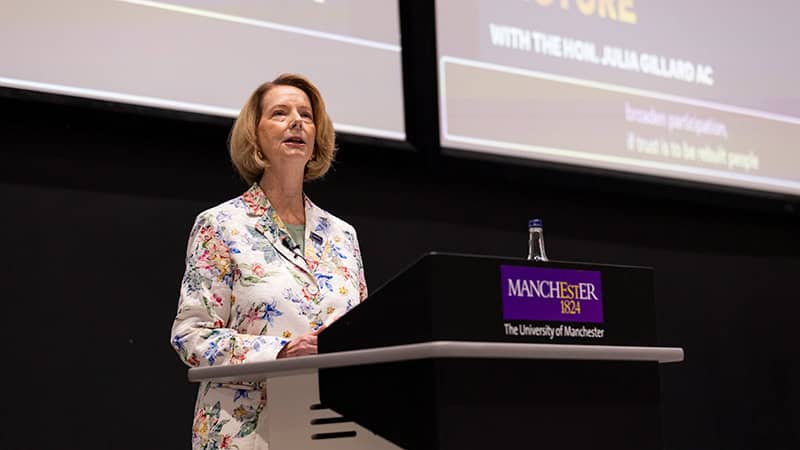
Speaking after delivering the University of Manchester’s annual Cockcroft Rutherford Lecture on Wednesday evening, Gillard was asked whether she had reflected on any “unintended consequences” of including gender identity in the Act. The question referenced the ongoing Giggle v Tickle case.
“I’m not sure if this is going to be too interesting to audience, because it’s a very Australian matter, but let me just respond in the following way. If you look at the parliamentary debate in the changes to the Sex Discrimination Act in 2012, you’ll find that the issues you are referring to were not raised by anyone, because they simply weren’t a matter of public discourse they way they are today.
“So it was a different time. It wasn’t something squarely before the parliament at the time that the legislation was being amended, so I think we make an error in uplifting what we know now, and public discourse now, and just putting it down 14 years ago.” Gillard said.
She declined to comment on the Giggle v Tickle case, noting that it remains before the courts.
Gillard’s comments have been seized upon by women’s group who oppose transgender rights and recognition, and conservative politicians.
Sall Grover, the CEO of the social media app Giggle for Girls, who the court found to have discriminated on the basis of gender identity under the act when she barred a transgender woman from accessing her company’s services, said the former PM’s comments should prompt the current government to change the act. Grover is currently taking the case to the High Court.
“The onus is now on Albanese to do something, and he will regret it if he doesn’t,” Grover told The Australian newspaper. “History will judge him. People want this. This is a very easy political win.”
The government has not shown any appetite to change the act. This week both One Nation and the Liberals attempted to introduce legislation into the senate but both were blocked by Labor and The Greens. A private members bill from Nationals member Alison Penfold was briefly debated in the Legislative Assembly.
Whether the former Prime Minister’s comments are an endorsement of changing the Sex Discrimination Act is open to interpretation, but it hasn’t stopped conservative groups from claiming that they are.
“Gillard’s new position is welcome.” the Family First Party said in a media release that also called for the Governor-General Sam Mostyn to step down as a patron of Equality Australia.
“It is a salient warning for politicians who all too often willingly accept whatever LGBTQA+ political activists tell them.” the party said.
A spokesperson for One Nation told The Australian newspaper that not only did they want to change the Sex Discrimination Act, they also maintained their call for a Senate Inquiry into the medical treatments available to people who are transgender, and health bodies who have taken action against medical professionals who have made statements about transgender issues.
While Liberal party senator Michaelia Cash also repeated her call for the laws to be changed immediately.