


Lex Watson was at the forefront of bringing change to Australia
Gay rights activist Lex Watson passed away on 6 May 2014.
Watson was born in Perth in 1943. He spent some of his formative years in Geraldton before attending Perth Modern School and the University of Western Australia, where he won a scholarship and studied History, English and Philosophy.

Watson moved to Sydney to continue his studies and later taught politics in the Government Department at the University of Sydney. He became passionate about the rights of gays and lesbians and became involved in law reform, joining the ACT Homosexual Law Reform Society in 1970.
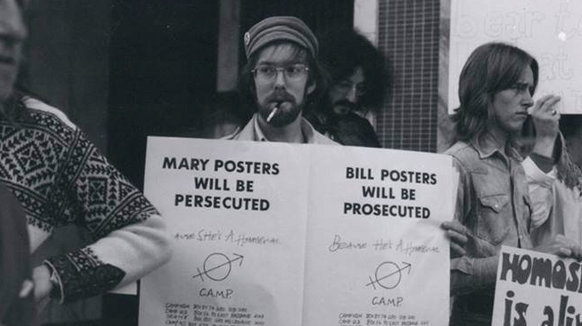
He was a founding member of Campaign Against Moral Persecution (CAMP), Australia’s first openly homosexual rights organisation. Watson has been credited with consolidating the group and helping pave the way for LGBT rights in Australia as its first co‑president.
In 1976 he appeared on the ABC program Monday Conference to discuss the issue of gay rights. The interview was filmed in Mount Isa, Queensland, in front of a hostile live audience.
At one point a member of the audience threw excrement at Watson, while another claimed the Cyclone Tracy disaster in Darwin was a message from God in response to the growing number of visible gay people in Australia.
Audience members asked questions that would astound Australians today, but one by one Lex Watson defended gay people from a wide range of often incredulous accusations.
Warning: This video has comments which might be distressing to some readers. For 24-hour crisis support and suicide prevention call Lifeline on 13 11 14. For Australia-wide LGBTQI peer support call QLife on 1800 184 527 or webchat.
Watson spent his life advocating for the rights of the LGBT community and helped create a dialogue between the gay and medical communities during the emergence of public awareness of HIV/AIDS in the 1980s. He was a regular writer for the Sydney Star newspaper and continued to speak out for gay rights throughout his life.
He became the founding president of the AIDS Council of NSW in 1985, and also founded the NSW Gay and Lesbian Rights Lobby. In later years Watson became dedicated to recording the history of the LGBT community and served as president of the Pride History Group.
A month after his passing he was posthumously appointed a Member of the Order of Australia in the Queen’s Birthday Honours. Watson had been informed of the award prior to his death.

Film star Marlene Deitrich died on this day in 1992
Marlene Dietrich was a German actress and singer who became a major Hollywood star in the 1930s.
Born in Berlin in 1901, Dietrich grew up in a comfortable middle‑class family and began her acting career on the stage in the early 1920s. She gained international fame for her role as the seductive cabaret singer Lola‑Lola in the 1930 film The Blue Angel, which marked her first collaboration with director Josef von Sternberg. She went on to make several successful films in Hollywood, including Morocco, Shanghai Express and Destry Rides Again.
Dietrich was known for her androgynous style and her portrayal of strong, independent women on screen. She often played characters who were confident, self‑assured and unafraid to challenge gender norms.
Her off‑screen persona was similarly unconventional, and she was admired for her daring fashion choices and outspoken views on politics and social issues. During World War II, Dietrich became a staunch anti‑Nazi activist and used her fame to support the Allied war effort, performing for troops and selling war bonds.
Despite her success in Hollywood and her status as a cultural icon, Dietrich remained a private and enigmatic figure throughout her life. She retired from the screen in the 1970s and spent her later years in seclusion, rarely granting interviews or making public appearances. She did, however, remain politically active, reportedly calling world leaders including Ronald Reagan, Mikhail Gorbachev and Margaret Thatcher to share her thoughts.
She died in Paris in 1992 at the age of 90, leaving behind a legacy as one of the most influential actresses of the 20th century. It has been widely acknowledged that Dietrich was bisexual and had many romances throughout her life.
Dietrich is referenced in many popular songs: she is mentioned in Rodgers and Hart’s The Most Beautiful Girl in the World, is the titular “Marlene on the Wall” for Suzanne Vega, and is name‑checked in Madonna’s Vogue.
In 1868 the word homosexual was written for the first time
The word homosexual was written for the first time on this day. In 1868 the words homosexual and heterosexual were recorded for the first time in a letter.
Karl‑Maria Benkert was born in Austria. He was the first writer to use the words homosexual and heterosexual. Prior to his writings, people had been described as sodomites or pederasts. He also proposed that people who only masturbated should be called monosexual.
As a young man he worked as a bookseller’s apprentice. He later recounted that he had a young friend who was gay; when someone discovered the friend’s sexuality, they attempted to blackmail him. The young man sadly took his own life rather than be exposed.
When he was 23, Benkert changed his name to Kertbeny — a name with more aristocratic associations.
After a stint in the army he began working as a journalist and travel writer, publishing at least 25 books. In the late 1860s he began to write extensively about homosexuality, coining the term himself. While he publicly claimed that his interest was anthropological, describing himself as “normally sexed”, his diaries revealed that he was most likely homosexual.
In his writing, Kertbeny argued that people who were same‑sex attracted were not possessed by the devil or driven by evil, but were born with their sexual orientation and that it was unchangeable. He also challenged the notion that gay men were effeminate and highlighted that many heroes throughout history were thought to be gay.
Kertbeny did not live to see his terminology become widely used around the world. He died in Budapest in 1882, aged 58. In recent years the local gay community has placed a new tombstone at his grave, and it has become part of their annual Pride celebrations to lay a wreath at his resting place.
In 1933 the Insititute of Sexual Service in Berlin was destroyed
The Institute of Sexual Science opened in Berlin in 1919 and was founded by Magnus Hirschfeld, a German sexologist and physician.
It was attacked and destroyed on this day by young Nazis. A few days later the Institute’s priceless collection of more than 20,000 books and 5,000 photographs was publicly burned.
Just over a year later, on 28 June 1934, Hitler conducted a purge of gay men in the ranks of the Sturmabteilung branch of the military. Referred to as the Night of the Long Knives, it was a major turning point in the treatment of minorities under Nazi rule. At least 85 people were murdered, and it is estimated that the final death toll from those arrested and later executed could be as high as 1,000.
Noah Galvin celebrates his birthday
Actor Noah Galvin celebrates his birthday today. Born in 1994, he’s best known for playing Kenny O’Neal in the TV series The Real O’Neals, which ran for two seasons from 2016. The show focuses on Kenny’s life after he comes out to his conservative Catholic family.
Galvin was the second person to play the lead role in the Broadway musical Dear Evan Hansen, taking over from Ben Platt, who originated the role. Years later Galvin and Platt began dating, and they married in 2024.
Galvin has gone on to appear in the TV series The Good Doctor, where he played Dr Asher Wolke.