


A majority of Hungarians, 69%, believe demonstrations and marches to advance LGBT rights should be allowed, according to a representative opinion poll conducted by the country’s polling agency Medián following the nation’s recent election.
In April, Péter Magyar and his TISZA party were elected to government, ending 16 years of conservative rule under Viktor Orbán. During the Orbán government, there were significant restrictions placed on LGBTIQA+ communities. Last year, the government declared the Pride parade would be banned – however, the event went ahead, with more than 100,000 people attending.

The new poll shows that support for Pride is even higher in Budapest, where 77% of residents back the event. Overall, 58% of respondents said school curriculums should include topics such as homosexuality and gender diversity.
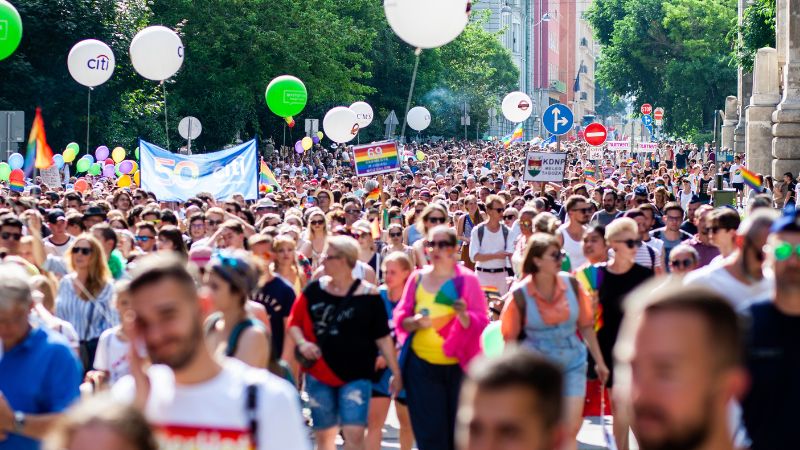
Although this year’s Budapest Pride was not banned by police, legal provisions remain in place prohibiting gatherings that “promote or display homosexuality, gender reassignment, or deviation from gender identity at birth”, as well as restricting access to such content for those under 18.
However, these laws do not appear to have majority support. Previously published data indicates that 57% of Hungarians would repeal laws restricting LGBT rights introduced under the previous Fidesz-KDNP government.
The Medián survey, conducted shortly after the April 2026 election, examined attitudes towards these laws and related issues in more detail.
It found that 69% of respondents support the right to organise LGBT-related demonstrations, 60% believe the state should not control which social groups are represented in daytime television and films, and 58% support age-appropriate education about homosexuality and gender diversity in schools.
Opposition to banning Pride events is not new. When the proposal was debated in parliament last year, Medián found that only 27% of Hungarians supported a ban.
At the same time, views on Pride itself remain mixed. While 21% explicitly supported Pride, 28% said its goals were important but considered the event too provocative. A further 22% did not support its aims but opposed banning it.
The survey also highlights demographic and political divides. Support for LGBT-related demonstrations is highest in Budapest and major cities, at 77% and 78% respectively, compared with 65% in smaller towns and 61% in villages.
Younger respondents are significantly more supportive. Among people aged 30-39, support stands at 86%, compared with 58% among those aged 65 and older. Education is also a factor, with 84% of university-educated respondents supporting the right to assemble, compared with 53% of those with vocational education.
Political affiliation shows the largest gap. Support is lowest among voters for Mi Hazánk, at 21%, and Fidesz voters, at 29%, while 88% of TISZA party supporters back the right to organise LGBT-related demonstrations.
The research was commissioned by the Háttér Society and conducted by the Median Public Opinion and Market Research Institute. The survey was carried out by phone between 27 April and 2 May 2026, with a sample of 1,003 people. The results are representative by gender, age, location and education level.