

Premium Content:

Malaysian newspaper publishes "How to Spot Gays and Lesbians' article

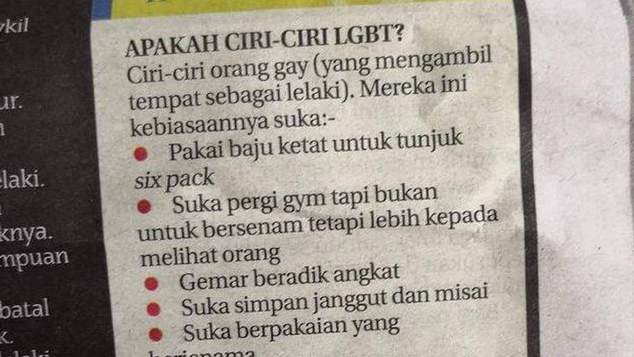
A Malaysian newspaper has published an article outlining how you can spot gay and lesbian people in society, sparking outrage among activists.

- Advertisement -

Homosexuality is illegal in Malaysia and activists for LGBTI rights have expressed their alarm at the article which lists traits it attributes to gay and lesbian people.

Leading newspaper Sinar Harian said gay men love going to the gym, are fond of beards and favour wearing designer clothing. It suggested people concerned about gay people should look out for people who ‘adopt’ others as their brothers or sisters, and said gay men’s ‘eye’s light up’ when a handsome man is around.

Gay men also are described as liking tight clothing because it allows them to show of their abdominal six packs.

The article said lesbians could be spotted because they dislike and belittle men, and often walk around holding hands with other women.

Malaysian social media personality Arwind Kumar is one of the many Malaysians hitting back at the article describing it as “stupid”.

In a YouTube video Kumar said he knew “a lot of ustads”, or Islamic scholars, “a lot of really, really religious people who love keeping beards”. “Are you trying to say they are gay? That’s how stupid this is,” he said.

The article also quote religious preacher Hanafiah Malik who argues that acceptance of LGBTI people needs to be stopped.

Hanafiah argues that “khunsa”, which literally means a “hermaphrodite”, or a person with both the male and female genitals, should be operated upon so there is no ambiguity about their gender.

OIP Staff


Support OUTinPerth

Thanks for reading OUTinPerth. We can only create LGBTIQA+ focused media with your help.

If you can help support our work, please consider assisting us through a one-off contribution to our GoFundMe campaign, or a regular contribution through our Patreon appeal.

Become a Supporter→     Make a contribution→ 


Latest

Celebrity Traitors: Fashion, Fangirling and the Famous

Celebrity Traitors UK returns with celebrity fangirling, bold fashion and suspicious behaviour.

Funding opportunities for new and emerging filmmakers

Two funding programs offer documentary and short film grants, supporting emerging filmmakers and LGBTQIA+ Australian storytellers.

We value connection, but are drifting apart

New research finds Australians value connection and belonging, but many feel increasingly disconnected, with implications for mental health.

‘CryBaby’ by Mabel Gibson wins at WA Premier’s Book Awards

Yamatji writer Mabel Gibson claimed two major WA Premier's Book Awards, with judges praising her debut memoir 'CryBaby'.

Newsletter

Don't miss

Celebrity Traitors: Fashion, Fangirling and the Famous

Celebrity Traitors UK returns with celebrity fangirling, bold fashion and suspicious behaviour.

Funding opportunities for new and emerging filmmakers

Two funding programs offer documentary and short film grants, supporting emerging filmmakers and LGBTQIA+ Australian storytellers.

We value connection, but are drifting apart

New research finds Australians value connection and belonging, but many feel increasingly disconnected, with implications for mental health.

‘CryBaby’ by Mabel Gibson wins at WA Premier’s Book Awards

Yamatji writer Mabel Gibson claimed two major WA Premier's Book Awards, with judges praising her debut memoir 'CryBaby'.

‘Elsinore’ brings to life the true life story of actor Ian Charleson

Andrew Scott stars as Ian Charleson in Elsinore, a new drama exploring fame, HIV and a pivotal Hamlet role.

Celebrity Traitors: Fashion, Fangirling and the Famous

Celebrity Traitors UK returns with celebrity fangirling, bold fashion and suspicious behaviour.

Funding opportunities for new and emerging filmmakers

Two funding programs offer documentary and short film grants, supporting emerging filmmakers and LGBTQIA+ Australian storytellers.

We value connection, but are drifting apart

New research finds Australians value connection and belonging, but many feel increasingly disconnected, with implications for mental health.